10 Books Similar to "A Whole New Mind: Why Right-Brainers Will Rule the Future"
by Daniel H. Pink
Drive: The Surprising Truth About What Motivates Us
"Drive" unpacks the surprising truth about human motivation, arguing that traditional reward-and-punishment systems are often ineffective, particularly for complex tasks. Pink champions intrinsic motivators—autonomy, mastery, and purpose—as the keys to sustained engagement, higher performance, and personal fulfillment in work and life.
Both books, penned by Daniel Pink, challenge conventional wisdom by advocating for a shift in perspective on how we approach work and life. While "A Whole New Mind" highlights the increasing importance of right-brain, conceptual skills in a changing economy, "Drive" delves into the psychological underpinnings of why those "right-brain" individuals, and indeed everyone, thrive when empowered by internal drivers rather than external incentives. They both explore adapting to modern environments by leveraging inherent human capabilities.
This book offers profound insights for anyone seeking to understand what truly energizes individuals and teams. Its principles are highly applicable for leaders, educators, and even individuals looking to cultivate greater personal drive. The practical framework and research-backed arguments provide a compelling roadmap for fostering environments where creativity, productivity, and satisfaction flourish.
Drive: The Surprising Truth About What Motivates Us
"Drive" unpacks the surprising truth about human motivation, arguing that traditional reward-and-punishment systems are often ineffective, particularly for complex tasks. Pink champions intrinsic motivators—autonomy, mastery, and purpose—as the keys to sustained engagement, higher performance, and personal fulfillment in work and life.
Both books, penned by Daniel Pink, challenge conventional wisdom by advocating for a shift in perspective on how we approach work and life. While "A Whole New Mind" highlights the increasing importance of right-brain, conceptual skills in a changing economy, "Drive" delves into the psychological underpinnings of why those "right-brain" individuals, and indeed everyone, thrive when empowered by internal drivers rather than external incentives. They both explore adapting to modern environments by leveraging inherent human capabilities.
This book offers profound insights for anyone seeking to understand what truly energizes individuals and teams. Its principles are highly applicable for leaders, educators, and even individuals looking to cultivate greater personal drive. The practical framework and research-backed arguments provide a compelling roadmap for fostering environments where creativity, productivity, and satisfaction flourish.
To Sell is Human: The Surprising Truth About Moving Others
"To Sell is Human" redefines "selling" beyond traditional transactions, arguing that we all spend significant time persuading, influencing, and "moving" others in our professional and personal lives. Pink introduces a refreshed, ethical approach to this pervasive activity, offering actionable strategies to leverage empathy, attunement, and clarity to achieve our goals and help others achieve theirs. It's a pragmatic guide for anyone navigating complex social interactions.
Both books, authored by Daniel Pink, share a fundamental focus on adapting to a shifting economic and social landscape. Just as "A Whole New Mind" posits that right-brain aptitudes like empathy and storytelling are increasingly crucial, "To Sell is Human" emphasizes these very qualities as essential for effective persuasion in a world awash with information and choice. They both champion a human-centric approach to modern challenges, advocating for skills that were once undervalued.
This book offers a powerful reframing of a concept often burdened by negative connotations, transforming "selling" into a skill set vital for personal and professional success in almost any field. Individuals will gain practical tools and a renewed perspective on how to influence effectively and ethically, fostering better communication and more positive outcomes in their daily interactions. It's an insightful exploration of human connection and its indispensable role in today's world.
To Sell is Human: The Surprising Truth About Moving Others
"To Sell is Human" redefines "selling" beyond traditional transactions, arguing that we all spend significant time persuading, influencing, and "moving" others in our professional and personal lives. Pink introduces a refreshed, ethical approach to this pervasive activity, offering actionable strategies to leverage empathy, attunement, and clarity to achieve our goals and help others achieve theirs. It's a pragmatic guide for anyone navigating complex social interactions.
Both books, authored by Daniel Pink, share a fundamental focus on adapting to a shifting economic and social landscape. Just as "A Whole New Mind" posits that right-brain aptitudes like empathy and storytelling are increasingly crucial, "To Sell is Human" emphasizes these very qualities as essential for effective persuasion in a world awash with information and choice. They both champion a human-centric approach to modern challenges, advocating for skills that were once undervalued.
This book offers a powerful reframing of a concept often burdened by negative connotations, transforming "selling" into a skill set vital for personal and professional success in almost any field. Individuals will gain practical tools and a renewed perspective on how to influence effectively and ethically, fostering better communication and more positive outcomes in their daily interactions. It's an insightful exploration of human connection and its indispensable role in today's world.
Smart Thinking: Three Essential Keys to Solve Problems, Innovate, and Get Things Done
"Smart Thinking" by Art Markman distills effective problem-solving into three core elements: understanding fundamental concepts, analogy-making, and managing mental capacity. It provides practical strategies for enhancing cognitive flexibility, breaking down complex issues, and leveraging existing knowledge to generate novel solutions in both professional and personal contexts, emphasizing a deliberate and strategic approach to intellectual challenges.
This book resonates with "A Whole New Mind" due to its shared emphasis on evolving cognitive skills for future success. While Pink focuses on the rise of "right-brain" aptitudes like empathy and storytelling, Markman zeroes in on the underlying cognitive mechanics – the "how" – of creative thinking and efficient problem-solving that are crucial for navigating and shaping an increasingly complex world, regardless of the industry.
It will appeal to individuals seeking concrete, actionable methods to improve their intellectual performance and drive innovation. This book offers a compelling roadmap for anyone looking to move beyond rote solutions, develop sharper analytical abilities, and consistently achieve better outcomes in their work and life.
Smart Thinking: Three Essential Keys to Solve Problems, Innovate, and Get Things Done
"Smart Thinking" by Art Markman distills effective problem-solving into three core elements: understanding fundamental concepts, analogy-making, and managing mental capacity. It provides practical strategies for enhancing cognitive flexibility, breaking down complex issues, and leveraging existing knowledge to generate novel solutions in both professional and personal contexts, emphasizing a deliberate and strategic approach to intellectual challenges.
This book resonates with "A Whole New Mind" due to its shared emphasis on evolving cognitive skills for future success. While Pink focuses on the rise of "right-brain" aptitudes like empathy and storytelling, Markman zeroes in on the underlying cognitive mechanics – the "how" – of creative thinking and efficient problem-solving that are crucial for navigating and shaping an increasingly complex world, regardless of the industry.
It will appeal to individuals seeking concrete, actionable methods to improve their intellectual performance and drive innovation. This book offers a compelling roadmap for anyone looking to move beyond rote solutions, develop sharper analytical abilities, and consistently achieve better outcomes in their work and life.
Imagine: How Creativity Works

"Imagine: How Creativity Works" delves into the intricate mechanisms of human creativity, examining its origins in neuroscience, psychology, and social dynamics. Jonah Lehrer explores how various factors, from urban environments to disparate cultural influences, cultivate innovative thinking, using compelling anecdotes of scientific breakthroughs and artistic masterpieces to illustrate his points. He presents creativity not as a monolithic gift, but a learnable process with distinct stages.
This book resonates with themes in "A Whole New Mind" due to their shared focus on the importance of human skills beyond purely analytical or logical thought in a rapidly changing world. Both authors argue for a greater emphasis on aptitudes traditionally associated with the "right brain"—such as imagination, storytelling, and synthesis—as crucial for future success and fulfillment. They highlight how these "soft skills" are becoming increasingly valuable in an age of automation and readily available information.
The book will appeal to individuals seeking to understand and harness their own creative potential, as well as those interested in the science behind innovation. It offers practical insights and a rich tapestry of examples that illuminate how creativity manifests and can be nurtured, providing a compelling roadmap for personal and professional growth in a world demanding innovative solutions.
Imagine: How Creativity Works
"Imagine: How Creativity Works" delves into the intricate mechanisms of human creativity, examining its origins in neuroscience, psychology, and social dynamics. Jonah Lehrer explores how various factors, from urban environments to disparate cultural influences, cultivate innovative thinking, using compelling anecdotes of scientific breakthroughs and artistic masterpieces to illustrate his points. He presents creativity not as a monolithic gift, but a learnable process with distinct stages.
This book resonates with themes in "A Whole New Mind" due to their shared focus on the importance of human skills beyond purely analytical or logical thought in a rapidly changing world. Both authors argue for a greater emphasis on aptitudes traditionally associated with the "right brain"—such as imagination, storytelling, and synthesis—as crucial for future success and fulfillment. They highlight how these "soft skills" are becoming increasingly valuable in an age of automation and readily available information.
The book will appeal to individuals seeking to understand and harness their own creative potential, as well as those interested in the science behind innovation. It offers practical insights and a rich tapestry of examples that illuminate how creativity manifests and can be nurtured, providing a compelling roadmap for personal and professional growth in a world demanding innovative solutions.
Blink: The Power of Thinking Without Thinking

"Blink" by Malcolm Gladwell explores the profound insights and accurate judgments we often make in an instant, without conscious deliberation. It dissects the concept of "thin-slicing"—our ability to extract meaningful information from minimal data—and illustrates how quick, intuitive decisions can be as powerful, and sometimes more effective, than extensive analysis. Gladwell uses diverse examples, from art connoisseurs recognizing fakes to military strategists making rapid battlefield assessments, to demonstrate the remarkable speed and surprising accuracy of our unconscious minds.
The similarity to "A Whole New Mind" lies in their shared emphasis on the increasing importance of non-linear, intuitive, and holistic thought processes. While Pink champions the "right-brain" qualities of creativity, empathy, and design in a world shifting beyond the Information Age, Gladwell directly illuminates the power and validity of rapid perception and instinctual judgment—facets deeply rooted in these same less analytical, more synthetic modes of thinking. Both books argue for valuing and harnessing cognitive abilities beyond purely logical, sequential reasoning.
This book will appeal to those intrigued by human psychology, decision-making, and the hidden mechanisms of our minds. It offers a compelling argument for trusting our gut instincts more often and understanding the complex interplay between our conscious and unconscious thought processes. The insights provided can enhance personal and professional decision-making, encouraging a more balanced appreciation for both deliberate analysis and spontaneous intuition.
Blink: The Power of Thinking Without Thinking
"Blink" by Malcolm Gladwell explores the profound insights and accurate judgments we often make in an instant, without conscious deliberation. It dissects the concept of "thin-slicing"—our ability to extract meaningful information from minimal data—and illustrates how quick, intuitive decisions can be as powerful, and sometimes more effective, than extensive analysis. Gladwell uses diverse examples, from art connoisseurs recognizing fakes to military strategists making rapid battlefield assessments, to demonstrate the remarkable speed and surprising accuracy of our unconscious minds.
The similarity to "A Whole New Mind" lies in their shared emphasis on the increasing importance of non-linear, intuitive, and holistic thought processes. While Pink champions the "right-brain" qualities of creativity, empathy, and design in a world shifting beyond the Information Age, Gladwell directly illuminates the power and validity of rapid perception and instinctual judgment—facets deeply rooted in these same less analytical, more synthetic modes of thinking. Both books argue for valuing and harnessing cognitive abilities beyond purely logical, sequential reasoning.
This book will appeal to those intrigued by human psychology, decision-making, and the hidden mechanisms of our minds. It offers a compelling argument for trusting our gut instincts more often and understanding the complex interplay between our conscious and unconscious thought processes. The insights provided can enhance personal and professional decision-making, encouraging a more balanced appreciation for both deliberate analysis and spontaneous intuition.
How the Mind Works

Steven Pinker's "How the Mind Works" offers a comprehensive exploration of the human mind from an evolutionary psychology perspective. It dissects complex cognitive functions like perception, reasoning, emotion, and language, explaining their origins and mechanisms as adaptations shaped by natural selection. Pinker demystifies how our brains create consciousness, process information, and engage with the world, drawing on research from cognitive science, artificial intelligence, and neuroscience.
The similarity to "A Whole New Mind" lies in both books' fundamental interest in understanding the human brain's capabilities and its implications for human endeavor. While Pink's focus is on the right-brain's ascendance in a changing economy, Pinker provides the deeper, foundational understanding of *how* the mind works across all its functions. Both authors challenge conventional thought about mental processes, prompting readers to reconsider human potential and adaptation.
This book will appeal to those who seek a rigorous, scientific explanation for the intricacies of human thought and behavior. Its value stems from providing a clearer understanding of our cognitive architecture, offering insights into why we think, feel, and act the way we do. It equips the curious mind with a robust framework for comprehending not just individual mental processes but also the broader societal and cultural manifestations of human intelligence.
How the Mind Works
Steven Pinker's "How the Mind Works" offers a comprehensive exploration of the human mind from an evolutionary psychology perspective. It dissects complex cognitive functions like perception, reasoning, emotion, and language, explaining their origins and mechanisms as adaptations shaped by natural selection. Pinker demystifies how our brains create consciousness, process information, and engage with the world, drawing on research from cognitive science, artificial intelligence, and neuroscience.
The similarity to "A Whole New Mind" lies in both books' fundamental interest in understanding the human brain's capabilities and its implications for human endeavor. While Pink's focus is on the right-brain's ascendance in a changing economy, Pinker provides the deeper, foundational understanding of *how* the mind works across all its functions. Both authors challenge conventional thought about mental processes, prompting readers to reconsider human potential and adaptation.
This book will appeal to those who seek a rigorous, scientific explanation for the intricacies of human thought and behavior. Its value stems from providing a clearer understanding of our cognitive architecture, offering insights into why we think, feel, and act the way we do. It equips the curious mind with a robust framework for comprehending not just individual mental processes but also the broader societal and cultural manifestations of human intelligence.
Everything Bad is Good for You: How Today's Popular Culture is Actually Making Us Smarter
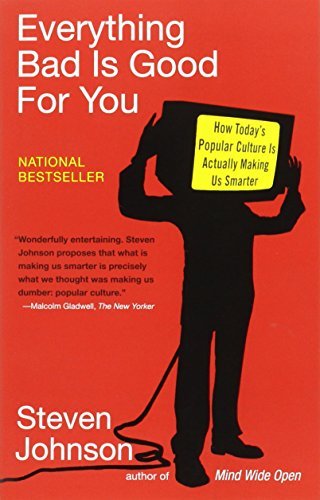
"Everything Bad is Good for You" challenges conventional wisdom, arguing that popular culture forms often dismissed as unintellectual – from video games to serialized dramas – actually cultivate sophisticated cognitive skills. Steven Johnson posits that these media demand complex problem-solving, pattern recognition, and nuanced social understanding, subtly enhancing our intelligence rather than dulling it.
This book aligns with "A Whole New Mind" by recognizing the evolving nature of valuable skills. While Pink champions right-brain attributes like empathy and synthesis in a changing economy, Johnson highlights a parallel development where popular culture fosters these very same attributes, albeit through unconventional channels. Both authors identify shifts in what defines intelligence and how it is developed, moving beyond traditional academic metrics.
This work offers a compelling re-evaluation of media consumption, providing a fresh perspective that validates engagement with popular culture. It encourages a more nuanced understanding of entertainment's cognitive benefits, empowering individuals to recognize and articulate the intellectual value gleaned from seemingly "unserious" activities. It is particularly valuable for those seeking to understand the subtle forces shaping modern thought and intelligence.
Everything Bad is Good for You: How Today's Popular Culture is Actually Making Us Smarter
"Everything Bad is Good for You" challenges conventional wisdom, arguing that popular culture forms often dismissed as unintellectual – from video games to serialized dramas – actually cultivate sophisticated cognitive skills. Steven Johnson posits that these media demand complex problem-solving, pattern recognition, and nuanced social understanding, subtly enhancing our intelligence rather than dulling it.
This book aligns with "A Whole New Mind" by recognizing the evolving nature of valuable skills. While Pink champions right-brain attributes like empathy and synthesis in a changing economy, Johnson highlights a parallel development where popular culture fosters these very same attributes, albeit through unconventional channels. Both authors identify shifts in what defines intelligence and how it is developed, moving beyond traditional academic metrics.
This work offers a compelling re-evaluation of media consumption, providing a fresh perspective that validates engagement with popular culture. It encourages a more nuanced understanding of entertainment's cognitive benefits, empowering individuals to recognize and articulate the intellectual value gleaned from seemingly "unserious" activities. It is particularly valuable for those seeking to understand the subtle forces shaping modern thought and intelligence.
Originals: How Non-Conformists Move the World
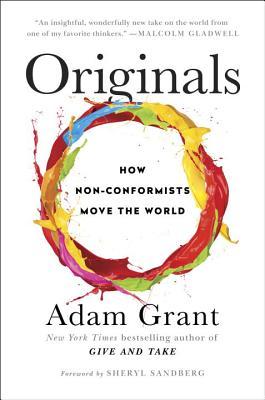
"Originals" by Adam Grant explores how groundbreaking ideas and movements arise not from conformity, but from individuals challenging the status quo. Grant delves into the psychology of original thinkers, revealing their shared traits, motivations, and the strategies they employ to effect change. He dismantles common myths about creativity and risk-taking, offering a fresh perspective on how anyone can cultivate originality and contribute meaningfully.
This book resonates with "A Whole New Mind" due to their shared emphasis on the increasing value of historically undervalued human capabilities. Pink argues for the ascendance of right-brain aptitudes like empathy and storytelling in a world saturated with information. Grant's exploration of non-conformity and innovative thinking directly complements this by showcasing individuals who leverage such "right-brain" traits—creativity, intuition, and the ability to challenge assumptions—to drive progress. Both books champion the power of unconventional approaches in an evolving landscape.
The book will appeal to those seeking to understand the mechanics of innovation and influence. It offers practical insights for fostering creativity, overcoming fear, and navigating resistance, whether in personal endeavors or professional settings. Its compelling case studies and research-backed arguments provide a compelling roadmap for anyone aspiring to break new ground and make a meaningful impact.
Originals: How Non-Conformists Move the World
"Originals" by Adam Grant explores how groundbreaking ideas and movements arise not from conformity, but from individuals challenging the status quo. Grant delves into the psychology of original thinkers, revealing their shared traits, motivations, and the strategies they employ to effect change. He dismantles common myths about creativity and risk-taking, offering a fresh perspective on how anyone can cultivate originality and contribute meaningfully.
This book resonates with "A Whole New Mind" due to their shared emphasis on the increasing value of historically undervalued human capabilities. Pink argues for the ascendance of right-brain aptitudes like empathy and storytelling in a world saturated with information. Grant's exploration of non-conformity and innovative thinking directly complements this by showcasing individuals who leverage such "right-brain" traits—creativity, intuition, and the ability to challenge assumptions—to drive progress. Both books champion the power of unconventional approaches in an evolving landscape.
The book will appeal to those seeking to understand the mechanics of innovation and influence. It offers practical insights for fostering creativity, overcoming fear, and navigating resistance, whether in personal endeavors or professional settings. Its compelling case studies and research-backed arguments provide a compelling roadmap for anyone aspiring to break new ground and make a meaningful impact.
Range: Why Generalists Triumph in a Specialized World
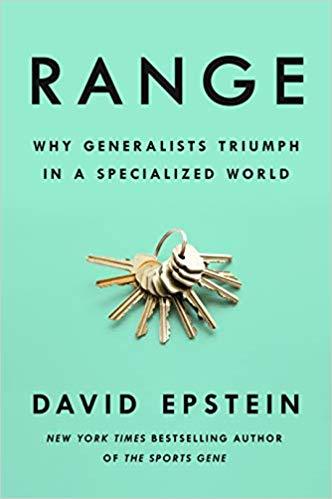
"Range" by David Epstein champions the generalist in an increasingly specialized world. It argues that broad experience across diverse fields, often through varied and meandering career paths, fosters superior adaptability, creativity, and problem-solving skills compared to early, narrow specialization. Epstein presents compelling evidence suggesting that many high achievers, from scientists to athletes, benefit from exploring multiple domains before finding their niche.
This book resonates with "A Whole New Mind" because both challenge the conventional wisdom about career development and intellectual success. Pink emphasizes the growing importance of "right-brain" aptitudes like empathy, storytelling, and design in an age of automation, while Epstein similarly highlights the value of holistic, interdisciplinary thinking over hyper-focused expertise. Both advocate for a broader, more human-centric approach to education and professional growth.
The book offers a compelling counter-narrative to the prevailing pressure for early specialization, providing a reassuring and empowering perspective for individuals navigating complex career landscapes. It encourages embracing diverse interests and a willingness to change course, ultimately demonstrating how a breadth of experience can lead to profound innovation and adaptability in a rapidly evolving professional environment.
Range: Why Generalists Triumph in a Specialized World
"Range" by David Epstein champions the generalist in an increasingly specialized world. It argues that broad experience across diverse fields, often through varied and meandering career paths, fosters superior adaptability, creativity, and problem-solving skills compared to early, narrow specialization. Epstein presents compelling evidence suggesting that many high achievers, from scientists to athletes, benefit from exploring multiple domains before finding their niche.
This book resonates with "A Whole New Mind" because both challenge the conventional wisdom about career development and intellectual success. Pink emphasizes the growing importance of "right-brain" aptitudes like empathy, storytelling, and design in an age of automation, while Epstein similarly highlights the value of holistic, interdisciplinary thinking over hyper-focused expertise. Both advocate for a broader, more human-centric approach to education and professional growth.
The book offers a compelling counter-narrative to the prevailing pressure for early specialization, providing a reassuring and empowering perspective for individuals navigating complex career landscapes. It encourages embracing diverse interests and a willingness to change course, ultimately demonstrating how a breadth of experience can lead to profound innovation and adaptability in a rapidly evolving professional environment.
How We Decide
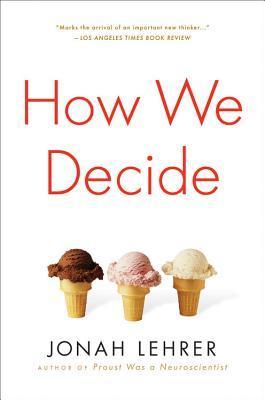
"How We Decide" delves into the intricate mechanisms of human decision-making, blending neuroscience and psychology to explore how our brains weigh options, process information, and ultimately arrive at choices. Jonah Lehrer illuminates the interplay between our rational and emotional minds, demonstrating how both conscious deliberation and intuitive insights shape our everyday actions.
This book shares thematic resonance with "A Whole New Mind" in its exploration of cognitive processes beyond purely logical, left-brained thinking. Both works advocate for a more holistic understanding of human intelligence, suggesting that our intuitive, emotional, and social capacities—often associated with "right-brain" functions—are critical for navigating a complex world and making effective judgments.
Individuals seeking to understand their own cognitive biases and improve their decision-making skills will find this book immensely valuable. It offers practical insights into optimizing personal and professional choices, providing a deeper appreciation for the complex interplay that underpins every judgment we make. The exploration of how eminent figures make crucial decisions further enhances its appeal.
How We Decide
"How We Decide" delves into the intricate mechanisms of human decision-making, blending neuroscience and psychology to explore how our brains weigh options, process information, and ultimately arrive at choices. Jonah Lehrer illuminates the interplay between our rational and emotional minds, demonstrating how both conscious deliberation and intuitive insights shape our everyday actions.
This book shares thematic resonance with "A Whole New Mind" in its exploration of cognitive processes beyond purely logical, left-brained thinking. Both works advocate for a more holistic understanding of human intelligence, suggesting that our intuitive, emotional, and social capacities—often associated with "right-brain" functions—are critical for navigating a complex world and making effective judgments.
Individuals seeking to understand their own cognitive biases and improve their decision-making skills will find this book immensely valuable. It offers practical insights into optimizing personal and professional choices, providing a deeper appreciation for the complex interplay that underpins every judgment we make. The exploration of how eminent figures make crucial decisions further enhances its appeal.
More Books to Explore
Discover more titles that expand on these ideas and themes.
Drive: The Surprising Truth About What Motivates Us
To Sell is Human: The Surprising Truth About Moving Others
Smart Thinking: Three Essential Keys to Solve Problems, Innovate, and Get Things Done
Imagine: How Creativity Works
Blink: The Power of Thinking Without Thinking
How the Mind Works