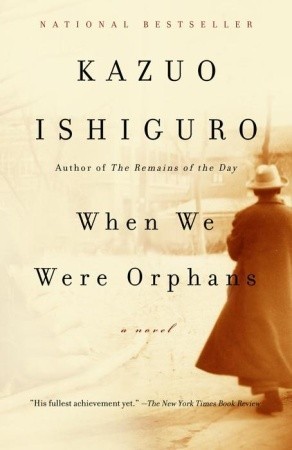
When We Were Orphans
Book Description
A brilliant detective haunted by the shadows of his childhood, Christopher Banks returns to a war-torn Shanghai in search of his long-lost parents. What begins as a quest for truth spirals into a labyrinth of memory, illusion, and loss, as Banks grapples with the ghosts of his past and the choices that shaped him. With every clue uncovered, the lines between justice and obsession blur, leading him down a path riddled with betrayal and heartbreak. Can he solve the mystery and reclaim the family he lost, or is he destined to remain forever adrift in his own memories?
Quick Book Summary
"When We Were Orphans" follows Christopher Banks, an English detective whose childhood in Shanghai was abruptly ended by the mysterious disappearance of his parents. Growing up in England as an orphan, Christopher dedicates himself to his profession, driven by a singular desire to unravel the enigma of his parents' fate. Years later, he returns to a war-torn Shanghai, determined to solve the case that has defined his life. The novel intricately weaves themes of memory, identity, and the elusiveness of truth, blurring the lines between reality and illusion. Christopher's pursuit is both an external investigation and an internal journey, exposing the unreliability of memory and the costs of obsession. Ishiguro crafts a haunting exploration of loss, longing, and the tenuous grip we have on our pasts.


Summary of Key Ideas
Table of Contents
The Unreliability of Memory and the Nature of Truth
Christopher Banks is introduced as an acclaimed detective in 1930s England. His meticulously ordered adult life starkly contrasts with his fractured childhood in colonial Shanghai, where his parents vanished under mysterious circumstances. The trauma of their loss becomes the central mystery directing his career and emotional life. Banks' journey is defined by his promise to reunite his family no matter the cost, shaping his every decision and relationship. It is only by solving his parents' mystery, he believes, that he will find peace and meaning.
Identity, Obsession, and the Quest for Closure
The narrative shifts between Christopher’s present matchless detective career and his formative years among the expatriate elite in Shanghai. Through nonlinear storytelling, Ishiguro explores how memory can be altered by longing and trauma. Christopher's recollections are hazy, sometimes fantastical, making both the reader and the protagonist question the veracity of his memories. His obsession with the case grows, and his grasp of reality becomes ever more uncertain, highlighting how easily the past can be reinterpreted through the lens of desire and loss.
The Impact of War and Political Turmoil
Returning to Shanghai amidst the Japanese invasion, Christopher is plunged into a chaotic and violent city. The war amplifies the confusion of his internal and external worlds. The devastation of Shanghai parallels Christopher's own inner devastation, as the city’s labyrinthine, collapsing streets mirror his faltering grasp of reality. As he chases leads and confronts old acquaintances, the line between detective work and delusion blurs. His quest for justice becomes tangled with his need for closure, as war and personal trauma merge.
Childhood Trauma and Its Lifelong Echoes
Throughout his investigation, Christopher encounters betrayals and disappointments that further challenge his beliefs about his parents and himself. He struggles to distinguish fact from fiction, manipulated by those around him as much as by his own hopes. The revelations he uncovers are partial and ambiguous; any sense of resolution proves illusory. Christopher’s relentless pursuit exposes the destructive potential of memory and obsession—how holding too tightly to the past can prevent one from living in the present.
Illusion versus Reality
Ultimately, "When We Were Orphans" becomes a poignant meditation on the human need for connection and understanding, even as closure remains out of reach. Through Christopher Banks, Ishiguro explores how individuals construct meaning from loss and illusion, and how the boundaries between personal and historical tragedy can become indistinguishable. The novel ends with Christopher coming to terms—however ambiguously—with his inability to recover what is lost, reminding us of the profound effects of childhood trauma, the deceptions of memory, and the limits of even the most determined quest for truth.
Download This Summary
Get a free PDF of this summary instantly — no email required.