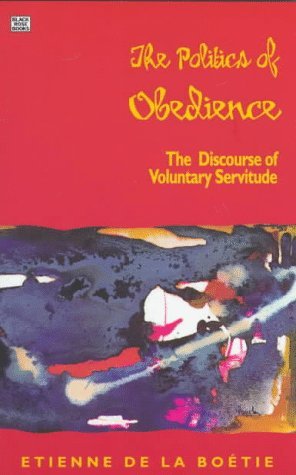
The Politics of Obedience: The Discourse of Voluntary Servitude
Book Description
What if freedom rests not in rebellion but in our own choice to serve? In 'The Politics of Obedience', Étienne de La Boétie unveils the unsettling truth behind tyranny—exposing how the masses willingly enslave themselves through complicity and acceptance. With razor-sharp insights, he challenges the very nature of power, revealing the extraordinary strength found in passive resistance. This provocative discourse explores the dynamics of authority and submission, peeling back layers of complacency that bind society. Can true liberation ever be achieved in a world where obedience is the norm?
Quick Book Summary
"The Politics of Obedience: The Discourse of Voluntary Servitude" by Étienne de La Boétie is a groundbreaking philosophical essay that explores the paradox of mass obedience to tyranny. Writing in the 16th century, La Boétie argues that all forms of oppressive government rely not merely on force, but on the willing complicity and passive submission of the very people they oppress. He provocatively suggests that tyrants hold power only because the populace consents, consciously or unconsciously, to their authority. Through incisive reasoning, La Boétie reveals that liberation is possible if people withdraw their support and refuse to serve. Highlighting the role of social habits, psychological conditioning, and networks of beneficiaries who uphold authority, the work exposes the mechanisms of voluntary servitude and calls for the awakening of individual and collective freedom. This classic text continues to challenge our understanding of power and resistance.



Summary of Key Ideas
Table of Contents
The Paradox of Voluntary Servitude
La Boétie begins by confronting a fundamental paradox: why do vast populations tolerate, even empower, tyrants who have little means to impose their will without consent? He observes that no government, however authoritarian, can maintain its rule on force alone. Rather, the primary reason for continued oppression is the voluntary obedience of subjects, shaped and reinforced by social and psychological factors. La Boétie insists that the greatest mystery is not the power of the ruler but the submission of the masses, who, knowingly or unknowingly, consent to their own servitude.
Mechanisms of Tyranny and Consent
The essay deconstructs the workings of tyrannical authority by examining the mechanisms that ensure ongoing compliance. La Boétie explains how every regime, whether a single despot or an oligarchy, constructs systems of dependency and reward. Through patronage, privileges, and positions, rulers create networks that bind people to their authority. These networks extend influence and foster loyalty, ensuring that tyranny is maintained with minimal direct coercion because a substantial portion of society benefits from its perpetuation.
Psychology and Habituation of Obedience
Central to La Boétie’s argument is the psychological dimension of obedience. He addresses how customs, traditions, and habituation shape attitudes toward power. From childhood, individuals are conditioned to accept authority as natural and inevitable. Over time, this normalization renders resistance unthinkable for most, transforming servitude into a familiar and almost desirable state. La Boétie stresses the malleability of public opinion and reveals how tyrants exploit this to sustain voluntary subjugation.
Networks of Complicity and Interest
La Boétie also draws attention to the interplay of complicity among beneficiaries of tyranny. By distributing favors and manipulating interests, rulers cultivate a class of collaborators—officials, bureaucrats, and other dependents—who become invested in the system’s stability. These beneficiaries reinforce doctrine, suppress dissent, and propagate the illusion that resistance is futile or dangerous, thus creating an environment where servitude is self-reinforcing. The web of complicity is integral to the endurance of despotism.
The Path to Liberation through Refusal
Ultimately, La Boétie’s discourse is a radical call to passive resistance and non-compliance. He reminds readers that power is sustained by the cooperation of the many, not the ability of the few to dominate. Withdrawal of consent—by refusing to support, obey, or collaborate—renders tyranny powerless. The essay closes with the hope that, through awareness and moral courage, people can awaken from their conditioned obedience and reclaim their freedom. This message of self-liberation remains profoundly relevant to contemporary discussions of authority and civil resistance.
Download This Summary
Get a free PDF of this summary instantly — no email required.