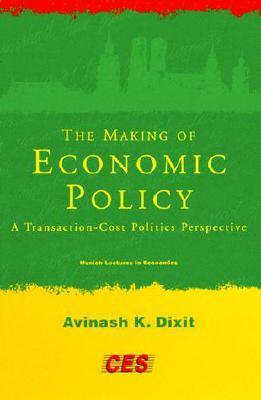
The Making of Economic Policy: A Transaction Cost Politics Perspective
Book Description
Economic policy isn't just a series of decisions—it's a high-stakes game of strategy, negotiation, and influence. Dive into the intricate web of transaction costs and political dynamics that shape the policies impacting millions. With bold insights and a fresh perspective, this book uncovers the hidden forces at play behind the scenes, revealing how economic decisions are often driven by power struggles and human behavior. As the climax builds, what unseen factors will dictate the fate of national economies? Can the future of economic policy break free from the chains of historical precedents?
Quick Book Summary
"The Making of Economic Policy: A Transaction Cost Politics Perspective" by Avinash K. Dixit reframes economic policy not as a series of textbook decisions but as a complex process shaped by transaction costs, strategic behavior, and political negotiation. Dixit argues that policy outcomes are not simply determined by ideal economic models or benevolent planners, but by the practical constraints and incentives facing policymakers, interest groups, and institutions. By applying the concept of transaction costs—a core idea from economics that focuses on the costs incurred during exchanges—Dixit illuminates how real-world frictions, bargaining, and informational inefficiencies influence the design and execution of economic policy. The book explains why seemingly logical reforms often founder, how institutional structures matter, and why politics cannot be separated from the economic policymaking process.



Summary of Key Ideas
Table of Contents
Transaction Costs in Policymaking
Dixit opens with a critique of the traditional economic analysis of policy, which treats government action as if driven by an all-knowing, public-spirited planner. In reality, policy decisions are shaped by transaction costs, which include the resources needed to negotiate, enforce, and monitor agreements among diverse parties. These costs are often substantial and shape the set of feasible policy choices. The recognition of transaction costs as central, rather than peripheral, reshapes how we understand both the successes and limitations of government interventions in the economy.
Strategic Behavior and Political Incentives
The book delves into strategic behavior, showing that policymakers are rarely neutral actors. They're influenced by varied incentives and face pressure from lobbying groups, bureaucratic interests, and constituents. Political actors engage in bargaining, coalition-building, and even deliberate obstruction, which can distort or undermine well-intentioned policy initiatives. The negotiation process is ongoing, with outcomes depending as much on political strategy as on sound economic analysis. In this context, achieving even modest policy improvements can be a significant challenge.
The Limits of Reforms and Institutional Change
Dixit examines why even compelling reforms routinely falter or produce unintended results. Transaction costs often arise from distrust, conflicting goals, or deeply entrenched interests. Institutional change is especially difficult when powerful groups benefit from the status quo, or when reformers can’t credibly commit to future actions. The book draws on game theory and political economy to illustrate why repeated failures are normal, and why incrementalism is often the only realistic path forward in policy evolution.
Information, Commitment, and Credibility
A crucial insight is the role of information, commitment, and credibility in successful policy implementation. Policymakers frequently operate in environments of imperfect information, making it hard to assess the outcomes and design appropriate incentives. Credible commitments—such as independent central banks or well-designed legal frameworks—can help reduce transaction costs, but constructing such institutions requires overcoming political resistance and coordination problems. Dixit underscores the perpetual challenge of ensuring that promises made by policymakers today will be honored in the future.
Interplay Between Economics and Politics
Ultimately, the book highlights the inseparability of economics and politics in real policy-making. Economic models provide useful frameworks, but actual policies are forged in a world where strategic calculation and institutional structures dominate. By viewing policy through the lens of transaction cost politics, Dixit offers a more nuanced, pragmatic understanding of why good policy is so hard to achieve. He closes with cautious optimism about the prospects for improvement, emphasizing gradual institutional learning and adaptation over sweeping, unrealistic reforms.
Download This Summary
Get a free PDF of this summary instantly — no email required.