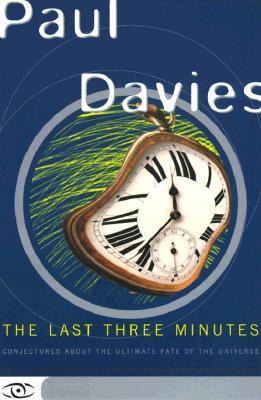
The Last Three Minutes
Book Description
What if the universe's ultimate fate hinged on the last three minutes of existence? In "The Last Three Minutes," Paul C.W. Davies delves into the mind-bending possibilities of cosmic demise and rebirth. With breathtaking clarity, he explores the extraordinary theories of black holes, time, and the fabric of reality itself. Every page pulses with the tension of questions unanswered and mysteries unresolved. As the clock ticks down, a profound journey into the depths of existence unfolds, challenging everything thought known about life and the universe. What revelations await as time runs out?
Quick Book Summary
"The Last Three Minutes" by Paul C.W. Davies is a captivating exploration of the universe’s ultimate fate, delving into the cosmic events that might unfold as time draws to a close. Davies blends physics, cosmology, and philosophical inquiry to examine scenarios for how the universe could end, including heat death, the big crunch, and the influence of black holes. He discusses the second law of thermodynamics, the irreversible march of entropy, and how these could dictate the final conditions of existence. Balancing scientific rigor with accessible prose, Davies guides readers through mind-bending theories about time, matter, and life’s persistence in the face of cosmic extinction. The book is a deeply thought-provoking meditation on cosmic impermanence and the mysteries that linger at the edges of scientific understanding.


Summary of Key Ideas
Table of Contents
The Universe’s Potential Endings
Paul C.W. Davies begins by setting the cosmic stage, describing the vast timescales over which the universe has evolved and the physical laws that govern its trajectory. The story of the cosmos is recounted from the big bang through to the present era, emphasizing the processes that make cosmic longevity possible. Scientific advances have revealed not only the origins of the universe but have also allowed physicists to project forward, contemplating how the end might come about. Davies invites readers to grasp the scale and drama of cosmic history as a way to frame the mind-bending endgame that the book will investigate.
Entropy and the Arrow of Time
Central to the fate of the universe is the concept of entropy and the second law of thermodynamics. Davies explains how entropy, the measure of disorder, will dominate the universe’s future, leading to inevitable decay and the so-called heat death scenario. In this vision, all energy gradients eventually fade, stars die out, and matter collapses into inertness. The arrow of time, as governed by increasing entropy, means that complexity and life become unsustainable on cosmic scales. This principle serves as the backbone of most scientific projections regarding the universe’s ultimate end.
The Role of Black Holes in Cosmic Fate
Beyond heat death, Davies explores other possible cosmic finales, such as the big crunch (where gravity reverses expansion and contracts the universe) and the powerful influence of black holes. Black holes, fascinating objects that warp space and time, are key players: they can outlive stars and galaxies, absorbing matter as the last sources of structure. Davies discusses Hawking radiation and the slow evaporation of black holes, considering how even these titanic remnants eventually vanish, leaving behind a silent, empty cosmos.
Philosophical Implications of Cosmic Extinction
The physical possibilities of cosmic demise naturally provoke philosophical questions about existence, purpose, and the nature of time. Davies delves into these issues, pondering whether the end of the universe implies the permanent cessation of consciousness, information, and meaning. He speculates on possible cosmic rebirths, such as cyclic models or quantum mechanisms that could allow universes to spawn anew from their ashes. In doing so, the book bridges science and philosophy, encouraging reflection on humanity’s place in the vast, fleeting cosmos.
Frontiers of Cosmological Understanding
Ultimately, "The Last Three Minutes" challenges our understanding of reality’s limits and highlights the mysteries that remain at the frontiers of physics. Davies concludes by emphasizing the tentative nature of our knowledge and the thrill of cosmic inquiry. He underscores the humility required in the face of the universe’s complexity, reminding us that end-of-time scenarios, while theoretically grounded, remain open to future discovery, new physics, and possibly awe-inspiring surprises that science has yet to reveal.
Download This Summary
Get a free PDF of this summary instantly — no email required.