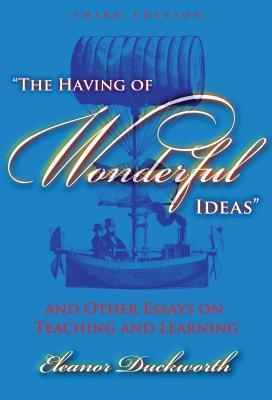
The Having of Wonderful Ideas and Other Essays on Teaching and Learning
Book Description
Imagine a classroom where curiosity reigns, where questions spark genuine exploration, and where every student’s idea becomes a vibrant piece of a larger puzzle. In 'The Having of Wonderful Ideas and Other Essays on Teaching and Learning,' Eleanor Duckworth passionately illuminates the transformative power of teaching that prioritizes understanding over rote memorization. With a captivating blend of personal anecdotes and profound insights, she challenges conventional methods, revealing how fostering a culture of wonder can ignite brilliant minds. What if the key to lifelong learning lies not in what is taught, but in how it is experienced?
Quick Book Summary
Eleanor Duckworth’s "The Having of Wonderful Ideas and Other Essays on Teaching and Learning" explores the transformative role of curiosity within education. Drawing from her work as a student of Jean Piaget and as an educator, Duckworth champions classrooms centered on inquiry, exploration, and the fostering of students’ own ideas. The essays illustrate how valuing students’ questions—and honoring their unique ways of understanding—encourages deep learning that transcends rote memorization. Duckworth emphasizes the importance of creating environments where learners feel safe to experiment and are encouraged to make sense of concepts on their own terms. By sharing personal stories and practical classroom examples, she strongly advocates for teaching that helps students become engaged, independent thinkers who see learning as an ongoing, lifelong process.



Summary of Key Ideas
Table of Contents
Nurturing Curiosity and Wonder
Duckworth centers her philosophy on nurturing curiosity and wonder, arguing that genuine learning begins with learners’ own questions. She sees the classroom as a vibrant space where all ideas are valued and students feel free to express their thoughts, however tentative or unformed. This openness to student ideas transforms the learning environment into one of discovery, where deeper understanding is built as learners wrestle with their own uncertainties and are supported in making sense of new information.
Learning Through Personal Exploration
She emphasizes that personal exploration is a catalyst for meaningful understanding. Duckworth provides compelling examples where learners, given opportunities to investigate real phenomena, move beyond rote procedures to construct their own frameworks of knowledge. Through hands-on activities, dialogue, and reflective thinking, individuals experience firsthand the joys and challenges of figuring things out themselves. Duckworth shares instances from the classroom, showing how exploration, rather than direct instruction, allows students to develop ownership of ideas.
Teacher as Facilitator of Understanding
In Duckworth’s view, the role of the teacher shifts from dispenser of knowledge to facilitator of understanding. Teachers are called to listen carefully, pose thoughtful questions, and resist the urge to immediately correct or direct. By observing students’ reasoning and building on their insights, teachers nurture intellectual autonomy and persistence. Duckworth urges teachers to be patient co-investigators, valuing students’ processes as much as their conclusions, thus honoring each child’s unique learning path.
Valuing Mistakes and Uncertainty
Valuing mistakes and uncertainty is central to Duckworth’s educational vision. She encourages embracing confusion and error as natural—and even necessary—parts of the learning journey. When students feel safe making mistakes, they become more willing to take intellectual risks and pursue challenging questions. Duckworth illustrates how misconceptions can serve as powerful starting points for deeper understanding, fostering resilience and a growth mindset.
Promoting Lifelong Independent Thinking
Ultimately, Duckworth advocates for education that promotes lifelong, independent thinking. By creating classrooms where students are agents of their own learning, teachers help cultivate habits of inquiry that extend far beyond academic settings. Duckworth’s stories and insights reveal how this approach prepares learners not just for tests, but for the complexity of life itself, nurturing curiosity, creativity, and the joy of "having wonderful ideas."
Download This Summary
Get a free PDF of this summary instantly — no email required.