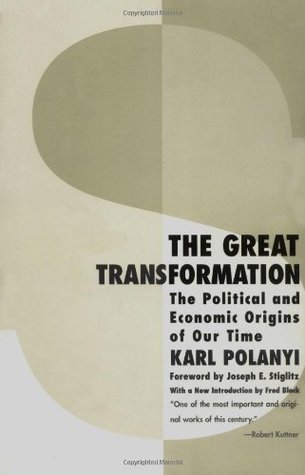
The Great Transformation: The Political and Economic Origins of Our Time
Book Description
Imagine a world where the very fabric of society is torn apart by the relentless forces of capitalism. In "The Great Transformation," Karl Polanyi unveils the dramatic collision between free market ideals and human values, revealing how this upheaval reshaped our political and economic landscape. Through vivid narratives and incisive analysis, he exposes the struggles of individuals caught in an escalating battle for their livelihoods and the soul of society itself. As communities grapple to reclaim their identities amidst industrial chaos, one question looms large: what happens when people choose humanity over markets?
Quick Book Summary
"The Great Transformation" by Karl Polanyi examines the profound shift in society as it transitioned into a market-driven economy in the nineteenth and early twentieth centuries. Polanyi argues that the development of a self-regulating market economy was not a natural evolution, but rather a radical and disruptive change that fractured the social fabric. He explores how communities, workers, and traditional forms of life were threatened as economic logic began to govern all aspects of existence. In response, societies enacted protective measures—sometimes politically and sometimes through grassroots movements—to resist the destabilizing effects of unregulated markets. Ultimately, Polanyi contends that subordinating social relations to market mechanisms leads to economic and political upheaval, and he calls for re-embedding economic activity within social norms and values.




Summary of Key Ideas
Table of Contents
The Rise of the Market Society
Polanyi begins by tracing the historical roots of the modern market society, challenging the belief that market economies are a natural development. Through analysis of English enclosure, industrialization, and the expansion of commerce, he illustrates how the creation of a self-regulating market required intentional legal and institutional changes. Land, labor, and money—what he calls "fictitious commodities"—were forcibly incorporated into the marketplace, disrupting traditional social relations that previously safeguarded communities and livelihoods.
Embeddedness of Economy in Society
He introduces the concept of embeddedness, emphasizing that economic systems have always been embedded within broader social structures and governed by social norms. The market society, however, sought to disembed the economy, treating previously sacred social relationships and resources as commodities subject to market logic. Polanyi demonstrates how this transformation undermined social solidarity and led to alienation and instability, as human needs and values were subordinated to profit motives and efficiency.
The Double Movement: Market Expansion and Social Protection
Central to Polanyi’s argument is the "double movement." As the market mechanism expanded, generating widespread insecurity and dislocation, society responded with protective counter-movements aimed at shielding people and resources from market forces. These responses ranged from labor unions and welfare legislation to protective tariffs and regulations. Thus, the expansion of markets was inherently accompanied by demands for social protection, creating ongoing tension between market logic and social needs.
Dislocation and Social Upheaval
The dislocation caused by the market’s encroachment led to economic, social, and political upheavals. Polanyi discusses how the unrestricted market contributed to crises such as the Great Depression, the rise of fascism, and the breakdown of democratic institutions. The commodification of land, labor, and money generated not only economic instability, but also deep moral and communal discontent, prompting populations and politicians to seek remedies—including authoritarian solutions—to restore security and meaning.
Lessons for the Modern World
Polanyi concludes by reflecting on the enduring lessons of the market society experiment. He urges that economies must be re-embedded within social relationships, prioritizing human well-being over abstract market efficiency. Polanyi’s analysis offers a cautionary lens for contemporary debates on globalization, deregulation, and social welfare, reminding readers of the dangers posed when markets dominate at the expense of society. "The Great Transformation" remains a seminal critique of market fundamentalism and a call for a humane alternative in political and economic life.
Download This Summary
Get a free PDF of this summary instantly — no email required.