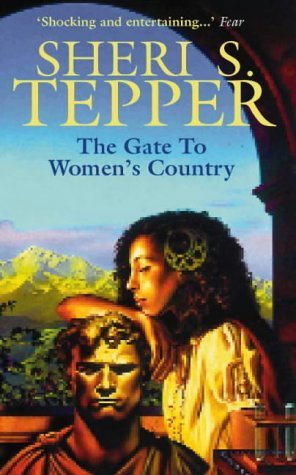
The Gate to Women's Country
Book Description
In a world scarred by centuries of conflict, women reign in a fortified sanctuary, shielded from the brutal chaos outside. But when a forbidden encounter threatens to unravel their carefully crafted lives, loyalties are tested and alliances forged in the shadows. As secrets surface and tensions escalate, the fragile peace hangs by a thread. Who holds the true power, and what sacrifices will be made to protect a future worth fighting for? In this gripping tale of resilience and rebellion, can a new generation break the chains of a fractured past, or will they fall prey to the same fate?
Quick Book Summary
"The Gate to Women’s Country" by Sheri S. Tepper is a provocative exploration of gender, power, and social engineering in a post-apocalyptic world. Centuries after a devastating war, society has split into strictly segregated spheres: women rule in walled cities called Women’s Country, while most men live in militaristic camps beyond the walls. The story follows Stavia, a young woman whose coming of age is marked by forbidden love, family tension, and the gradual revelation of her society’s secret history. Tepper uses Stavia’s journey to interrogate themes of sacrifice, the complexity of violence and peace, and the lengths to which a culture might go to avert the mistakes of the past. As the characters struggle with loyalty, independence, and the manipulation of truth, the novel asks if humanity can transcend its destructive instincts.





Summary of Key Ideas
Table of Contents
Gender and Power Dynamics
The novel presents a future world recovering from apocalypse, in which humanity has chosen radical solutions to survive. Within Women’s Country, society is organized along strict gender lines: women hold governance, manage reproduction, and live in urban security, while most men train and fight as warriors outside the city walls. Young boys are taken from their mothers at age five to live in the warrior camps, with only a select few, known as servitors, allowed to remain within the cities for specific duties. This structure is designed to prevent the recurrence of the violent mistakes that once destroyed civilization.
The Price of Peace and Security
The narrative unfolds largely through the perspective of Stavia, whose life exemplifies the challenges and contradictions of this matriarchal system. She navigates relationships with her mother, Morgot—a leader in Women’s Country—her childhood friend Chernon, and other key figures. Stavia’s forbidden liaisons and intellectual curiosity expose her to the deep rifts between the dominant city culture and the exiled warrior class. Through her experiences, the reader sees how traditions and rules are both protective and oppressive, and how personal desire sometimes collides with communal necessity.
Secrecy and Social Engineering
A major revelation is the city’s practice of eugenics and social engineering: women deliberately select which men may father children, aiming to breed out aggressive traits and thus promote lasting peace. The warrior men are unaware of this, believing they might someday be chosen for honor or return to city life, but in reality the matriarchal leaders pull all the strings. Stavia’s discovery of these secrets forces her to reckon with the moral ambiguities underpinning her society’s peace, and whether its ends justify the means.
Generational Change and Rebellion
The theme of generational change runs throughout the book, as Stavia and her peers grapple with their inheritance. Some rebel, longing for the old, violent ways or questioning the authority of their elders. Others internalize the lessons of sacrifice and restraint. The tension between progress and tradition, secrecy and transparency, defines the choices faced by both individuals and the collective. The cities’ mechanisms for maintaining order are always fragile, threatened by external and internal unrest alike.
The Cycle of Violence and Redemption
Ultimately, "The Gate to Women’s Country" offers a nuanced meditation on power, gender, and the cost of utopia. It submits that peace and justice may only be possible through difficult sacrifices and uncomfortable truths. Tepper leaves readers questioning whether escaping cycles of violence and subjugation is feasible, and if so, at what cost to freedom and compassion. The final pages do not offer easy answers, but instead highlight the enduring struggle to build a better world from the ashes of the old.
Download This Summary
Get a free PDF of this summary instantly — no email required.