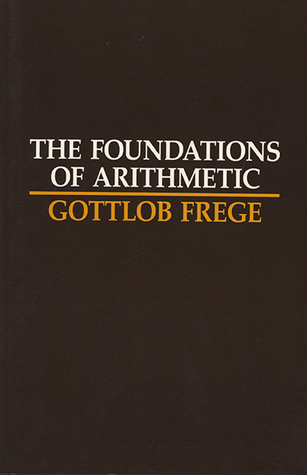
The Foundations of Arithmetic: A Logico-Mathematical Enquiry into the Concept of Number
Book Description
Numbers shape our world, yet their true essence remains shrouded in mystery. In "The Foundations of Arithmetic," Gottlob Frege embarks on a daring quest to unravel the tangled web of mathematical concepts, challenging accepted notions and illuminating the profound relationship between logic and numbers. With each revelation, the boundaries of mathematics blur, inviting readers to confront the very nature of reality itself. As Frege dismantles conventional ideas and constructs a bold new framework, one question gnaws at the core of this intellectual odyssey: What if understanding numbers unlocks deeper truths about existence itself?
Quick Book Summary
"The Foundations of Arithmetic" by Gottlob Frege is a landmark philosophical treatise that investigates the true nature of number. Frege critically examines prevailing definitions drawn from psychology and physical observation, arguing that numbers are not empirical entities but rather logical objects. Through rigorous analysis, he posits that the laws of arithmetic are analytic, grounded in logic and independent of subjective intuition. Frege introduces the concept of abstraction and the role of definitions in understanding the concept of number, most notably through his context principle—insisting that numbers must be understood within the framework of propositions. His work lays the groundwork for logicism, the thesis that mathematics is reducible to logic, and set the intellectual stage for the development of modern logic and analytic philosophy. Frege’s foundational insights resonate far beyond mathematics, inviting reflection on the relationship between language, logic, and reality.




Summary of Key Ideas
Table of Contents
The Logical Foundations of Numbers
Frege begins by questioning common understandings of numbers, critiquing the notion that they refer to empirical objects or are products of psychological processes. He challenges the prevailing view that arithmetic is grounded in sensory experience, arguing instead that numbers should be understood as objective entities independent of human perception. Through this lens, Frege articulates that the study of arithmetic must rely on pure logic rather than subjective intuition or the physical sciences.
The Context Principle and Abstraction
Central to Frege’s approach is his context principle, which holds that words have meaning only in the context of a proposition. Frege maintains that to truly grasp what a number is, we must consider how numerical terms function within statements. This insight leads him to propose an abstract and linguistic analysis of number, paving the way for definitions that avoid the ambiguities of psychologism and empiricism in mathematics.
Definitions and The Concept of Number
Frege then formulates the concept of number via abstraction, asserting that numbers are properties of concepts rather than physical aggregates. He provides a logical definition: the number assigned to a concept F is the class of concepts equinumerous with F. This move allows Frege to systematize how numbers relate to collections, laying the groundwork for higher-level mathematical reasoning without recourse to intuition or concrete examples.
Critique of Psychological and Empirical Accounts
Throughout the book, Frege offers detailed critiques of alternative theories, particularly those that reduce numbers to mental constructs or empirical observations. He exposes the weaknesses of psychological or physicalist theories, showing that they cannot supply the objectivity and universality demanded by mathematics. By doing so, Frege clears the path for understanding arithmetic as an autonomous, objective domain.
The Logicist Thesis and Its Implications
The treatise culminates in Frege’s logicist thesis—the claim that arithmetic can be derived from purely logical principles. He contends that mathematical truths are analytic, following from definitions and logic alone. Frege’s explorations not only revolutionize the philosophy of mathematics but also usher in a new era in logic, profoundly influencing thinkers like Russell and Wittgenstein. His insights continue to provoke debate on the nature of mathematical truth, meaning, and existence.
Download This Summary
Get a free PDF of this summary instantly — no email required.