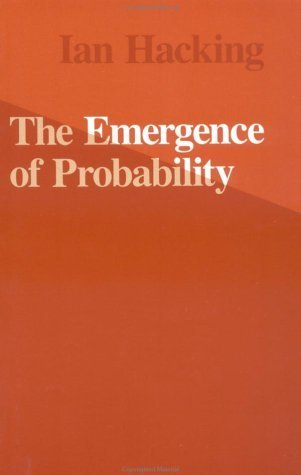
The Emergence of Probability: A Philosophical Study of Early Ideas About Probability, Induction and Statistical Inference
Book Description
Probability once seemed a mere anomaly of thought—an abstract puzzle to ponder. Yet, in "The Emergence of Probability," Ian Hacking unveils how this elusive concept transformed our understanding of uncertainty, weaving through history’s shadows to illuminate the fervent debates that shaped modern science. As ideas of induction and statistical inference clash and converge, the reader is thrust into a world where decisions swing on the razor’s edge of chance. What if the very fabric of knowledge we take for granted hinges on these early philosophical struggles? Discover the revolution that redefined how humanity confronts uncertainty. What truths lurk in the unpredictable?
Quick Book Summary
"The Emergence of Probability" by Ian Hacking traces the transformation of probability from an obscure logical puzzle to a foundational concept in philosophy, science, and mathematics. Hacking explores how 17th-century thinkers first grappled with problems of chance, uncertainty, and induction, gradually developing sophisticated tools for thinking statistically. He analyzes how philosophical debates about causality and reasoning underpinned the rise of probability theory, situating its emergence amid the broader intellectual shifts of the Enlightenment. The book reveals that ideas about probability and statistical inference were not inevitable; rather, they arose from deep questions about knowledge, evidence, and prediction. Hacking shows how these early developments continue to shape our understanding of science and decision-making to this day.



Summary of Key Ideas
Table of Contents
The Historical Context of Probability
During the Middle Ages and Renaissance, uncertainty was often seen as a defect of knowledge or a quirk of human reason rather than a domain to be studied systematically. Hacking surveys the prehistory of probability, where fate, chance, and fortune were matters for theology or moral debate rather than scientific scrutiny. He describes how early games of chance and insurance contracts slowly created pressure for more formalized ways of thinking about risk, but intellectual frameworks to handle uncertainty lagged behind practical needs.
Philosophical Challenges of Induction and Uncertainty
With the rising tide of scientific inquiry in the 17th century, philosophers and mathematicians began tackling problems of induction—how to infer general laws from particular observations—in new ways. Figures like Pascal, Fermat, and later Bernoulli tried to construct rules for reasoning when outcomes are uncertain. Hacking examines how their debates and correspondence, especially regarding gambling and life insurance, led to foundational insights about probability. Their efforts revealed not only mathematical patterns but deep epistemological puzzles about justifying belief under uncertainty.
The Birth of Statistical Inference
Statistical inference emerged as an effort to handle cases where data could inform predictions, but randomness obscured direct relationships. Hacking details how early probability theorists formulated the law of large numbers and considered the role of evidence in supporting hypotheses. The probabilistic view contrasted sharply with deterministic approaches, inviting fierce debate over whether nature itself was inherently unpredictable or simply appeared so due to human ignorance. This confrontation shaped the very methods of scientific experimentation and analysis.
Probability in Scientific Thought
The philosophical significance of probability stretched beyond mathematics, directly influencing Enlightenment thought and scientific methodology. Hacking shows how probability influenced theories of knowledge, shaping views on causality, explanation, and rational belief. Probability emerged as a tool for managing uncertainty not just in science but also in fields as diverse as law, economics, and insurance, reflecting a broader shift in how societies conceptualized risk and evidence.
Lasting Impacts on Knowledge and Method
Hacking concludes by demonstrating how the intellectual revolution around probability irrevocably changed the landscape of science and philosophy. The frameworks established in the early modern period laid a foundation for later developments in statistics, physics, and the philosophy of science. By confronting head-on the reality of uncertainty, these early thinkers provided tools and concepts that continue to underpin our attempts to understand and predict the world, making the study of probability central to modern epistemology and practice.
Download This Summary
Get a free PDF of this summary instantly — no email required.