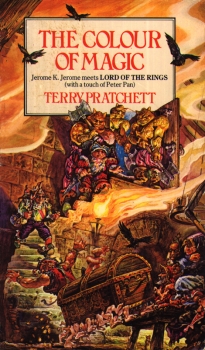
The Colour of Magic
Book Description
In a world where magic is as unpredictable as a drunken wizard, a thrilling journey begins on the flat, disc-shaped surface of the Discworld. Meet Rincewind, a cowardly wizard whose spells barely work and whose knack for survival leads him into outrageous encounters with fearsome dragons, a stunningly beautiful tourist, and bizarre creatures from legends. As chaos unfolds and danger looms, alliances are tested and courage is discovered in the most unexpected places. Will Rincewind find the bravery to transform his fate, or will the weight of the world crush the timid? Prepare for laughter, wonder, and a quest like no other—are you ready for a new adventure?
Quick Book Summary
The Colour of Magic, the inaugural novel in Terry Pratchett’s Discworld series, follows the reluctant wizard Rincewind as he’s roped into guiding the first-ever tourist, Twoflower, through the bizarre, perilous Discworld—a flat world carried by four elephants atop a giant space turtle. Rincewind, infamous for his incompetence and cowardice, is drawn into a disastrous chain of misadventures involving fire-breathing dragons, thieving guilds, angry gods, and mystical artifacts after a simple job of guiding Twoflower goes awry. With wit and irreverence, Pratchett satirizes sword-and-sorcery tropes as his hapless heroes stumble from one calamity to the next. Featuring clever parody, eccentric characters, and whimsical world-building, The Colour of Magic is a fast-paced, comedic fantasy brimming with magical chaos and philosophical fun. Along the way, Rincewind’s luck and improvisational skills are tested, questioning whether heroism is a matter of choice or accidental survival.




Summary of Key Ideas
Table of Contents
Satire of Fantasy Conventions
Terry Pratchett’s The Colour of Magic transports readers to the eclectic world of Discworld, a fantastical realm where logic bends and magical absurdity reigns. The story begins in Ankh-Morpork, a chaotic city where the bumbling wizard Rincewind meets Twoflower, the naive but optimistic tourist from the Counterweight Continent. Twoflower introduces the concept of insurance to the city, unwittingly causing chaos as people misunderstand and exploit the idea. Rincewind, despite being a failed wizard who knows only one dangerous spell, is coaxed into guiding Twoflower for a fee, hoping to stay alive while navigating Ankh-Morpork’s dangers.
The Nature of Luck and Cowardice
Their misadventures start with the city’s destruction by fire—thanks in part to Twoflower’s naive curiosity and the resulting unrest. Fleeing the burning Ankh-Morpork, accompanied by Twoflower’s sentient and fiercely protective Luggage, they embark on a journey across the Disc. Each new land delivers wild hazards: intelligent but invisible dragons conjured by belief, vengeful sea trolls, and encounters with the eccentric Wyrmberg, a floating mountain. Along the way, Pratchett weaves in sharp parodies of classic fantasy tropes, lampooning heroics, villainy, and the conventions of magical quests.
World-Building and Absurdity
Interweaving comedy and danger, Pratchett explores the curious partnership between Rincewind and Twoflower. Rincewind reluctantly plays the role of guide, persistently trying to escape danger. Twoflower remains unfazed, treating every near-death experience as an exotic photo opportunity, thanks largely to his unshakable optimism and blissful ignorance of peril. Their interdependence highlights perspectives on adventure—fear versus wonderment—and explores whether survival hinges on skill, luck, or sheer incompetence.
Role of Magic and Unpredictability
Magic in Discworld is capricious and unreliable, creating unpredictable predicaments for the protagonists. Rincewind’s single spell, accidentally lodged in his memory during his time at Unseen University, is both a curse and a lifeline but remains undeployed due to its mysterious power. The gods of Discworld treat mortals as pieces in a game, adding further unpredictability and cosmic humor to the journey. The duo’s volatility and the world’s magical uncertainty ensure that nothing proceeds as planned, emphasizing the chaos intrinsic to Pratchett’s universe.
Tourism and Perspective
By the novel’s close, Rincewind and Twoflower’s odyssey offers reflections on heroism and destiny. The pair’s survival often arises not from courage or competence, but from improbable luck and the unexpected consequences of their actions. Pratchett uses their calamity-ridden quest to lampoon fantasy fiction while celebrating its imagination, demonstrating how even the least heroic can find themselves at the center of extraordinary stories. The Colour of Magic lays the groundwork for the zany, satirical adventures that define the Discworld series.
Download This Summary
Get a free PDF of this summary instantly — no email required.