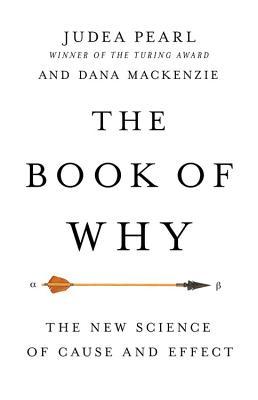
The Book of Why: The New Science of Cause and Effect
Book Description
What if understanding cause and effect could unravel the mysteries of our universe? In *The Book of Why*, Judea Pearl takes readers on a thrilling journey through the landscape of reasoning, challenging the ways we perceive the world. Armed with groundbreaking insights, he unveils the hidden structure of causality, transforming abstract statistical concepts into practical tools for real-life dilemmas. From AI to medicine, the implications are profound, reshaping how decisions are made and knowledge is constructed. As you navigate this intellectual adventure, ask yourself: what truths about your reality might be hiding in plain sight?
Quick Book Summary
"The Book of Why" by Judea Pearl revolutionizes how we think about cause and effect. Pearl argues that traditional statistical approaches often fall short when it comes to understanding causality. By introducing the "causal revolution," he provides a framework—based on causal diagrams and the "ladder of causation"—for distinguishing correlation from causation and for answering "what if" and "why" questions. This book explores how humans intuitively grasp causal relationships and how computers and artificial intelligence can be designed to do the same. Through historical anecdotes, real-world applications, and philosophical discussions, Pearl demonstrates the profound impact that understanding causality can have in fields ranging from medicine to social science. Ultimately, Pearl's work unleashes new tools to unravel mysteries and make better decisions in an uncertain world.


Summary of Key Ideas
Table of Contents
The Ladder of Causation
Pearl introduces the concept of the "ladder of causation," a framework that distinguishes between three levels of reasoning: association, intervention, and counterfactuals. At the bottom rung, systems recognize patterns and correlations. The next step involves interventions, where one actively manipulates variables to see outcomes. Finally, counterfactual reasoning allows us to ask "what if" questions about alternate realities. This ladder helps clarify what kinds of questions different methods can answer, showing that most statistical approaches remain stuck on the lowest level.
Causal Diagrams and the Language of Cause and Effect
A core innovation in Pearl’s work is the use of causal diagrams, or directed acyclic graphs (DAGs), which visually encode assumptions about how variables influence each other. By representing causes and effects through diagrams, researchers can map out the structure of causal relationships, test hypotheses, and identify potential confounders. These maps enable a systematic way to distinguish causal links from mere correlations, providing a powerful language to express and critique causal claims in both science and everyday reasoning.
From Correlation to Causation
Pearl critiques the historical focus on correlation in statistics, which often leads to misguided conclusions about cause and effect. He shows how reliance on correlation alone limits scientific discovery and decision-making, especially in complex systems where lurking variables or confounding factors can mislead. By contrasting traditional statistical methods with the tools of causality, he illuminates the transformation required to move beyond describing relationships to understanding mechanisms and predicting the results of interventions.
Interventions, Counterfactuals, and the Power to Ask "What If"
A highlight of the causal revolution is the formalization of counterfactuals—expressions about what would have happened if circumstances were different. Pearl’s framework quantifies and rigorously analyzes such scenarios, which are central to fields like law and medicine. The ability to model interventions and counterfactuals enables more precise policy evaluations, medical diagnosis, and risk assessment, effectively transforming the kinds of questions science and society can address.
Implications for Artificial Intelligence and Decision-Making
Finally, Pearl argues that adopting causal reasoning fundamentally changes artificial intelligence and data-driven decision-making. Traditional AI systems excel at pattern recognition but struggle with understanding cause and effect. By incorporating causal models, future AI systems could move beyond mimicry and correlations to reasoning about interventions and hypothetical outcomes, making them far more useful in domains like personalized medicine, economics, and policy. Pearl concludes that truly intelligent machines—and better human decisions—require a deep integration of causal inference into our logic and technology.
Download This Summary
Get a free PDF of this summary instantly — no email required.