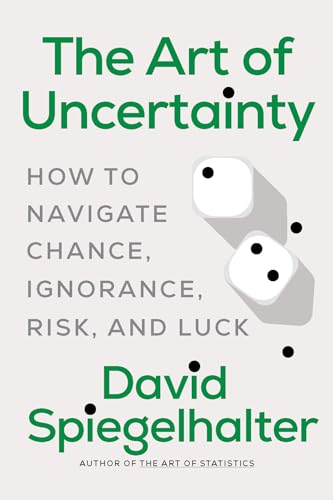
The Art of Uncertainty: How to Navigate Chance, Ignorance, Risk and Luck
Book Description
Life is a dizzying dance with uncertainty, where chance and risk shape every moment. In "The Art of Uncertainty," David Spiegelhalter unravels the intricate interplay of luck and ignorance that influences our decisions and destinies. Armed with engaging stories and sharp insights, he reveals how to wield uncertainty as a powerful tool, turning potential chaos into clarity. From weather forecasts to health statistics, this exploration challenges conventional wisdom and sparks a new understanding of probability's role in our lives. How will you embrace the unpredictable twists and turns that lie ahead?
Quick Book Summary
"The Art of Uncertainty" by David Spiegelhalter delves into the fundamental role that chance, risk, and ignorance play in everyday life and decision-making. Using real-world examples—from predicting the weather to medical diagnoses to financial investments—Spiegelhalter demonstrates how probability and statistical thinking can help us navigate life’s unpredictabilities. He reveals that while uncertainty can be unsettling, it also offers opportunity and insight if approached logically and creatively. The book explores the psychological strategies for coping with unknowns, the power and limitations of data, and how embracing uncertainty can lead to better choices. Ultimately, Spiegelhalter invites readers to rethink their relationship with unpredictability, using it as a tool for growth rather than a source of anxiety.


Summary of Key Ideas
Table of Contents
Understanding Chance and Probability in Daily Life
Life is inherently uncertain, and at every turn we face decisions shaped by chance and risk. Spiegelhalter begins by establishing that uncertainty is not merely an obstacle but an inescapable part of existence, embedded in everything from flipping coins to complex financial systems. By demystifying concepts like randomness, probability, and statistical inference, he enables readers to better interpret the data and probabilities that are part of daily choices. An informed understanding of how chance operates empowers individuals to avoid common errors in judgment and appreciate the limits of control.
Psychology of Risk Perception and Decision-Making
A major theme is how our minds perceive risk and deal with the unknown. Cognitive biases, such as overconfidence or aversion to ambiguity, can lead us astray. Spiegelhalter discusses psychological experiments and real-world scenarios in which emotions override logic, emphasizing the importance of slowing down, questioning assumptions, and acknowledging our natural limitations. Recognizing these mental pitfalls is crucial to making more rational decisions, especially in situations with high stakes or incomplete information.
Limits of Prediction and the Role of Ignorance
Prediction is a human impulse, but Spiegelhalter stresses the necessity of humility in the face of ignorance. He explains how models and forecasts—whether in weather, medicine, or economics—are riddled with uncertainty, and that overreliance on them can have serious consequences. Embracing ignorance by acknowledging what we do not know is not a weakness but a strength, leading to more robust designs and adaptable strategies. This awareness allows readers to make informed decisions while accepting the intrinsic unpredictability of complex systems.
Harnessing Luck and Navigating Uncertainty
The book explores the role of luck, both good and bad, highlighting that outcomes often hinge on factors beyond our control. Spiegelhalter uses anecdotes and research to show that luck interacts with preparation and risk management. By understanding how randomness operates, we can position ourselves to both capitalize on fortunate breaks and mitigate the setbacks from misfortune. This perspective shifts the narrative from blaming or crediting oneself too much for outcomes to cultivating resilience and flexibility.
Strategies for Embracing and Managing Unpredictability
Finally, Spiegelhalter offers practical approaches for embracing uncertainty rather than fearing it. He advocates the use of probabilistic thinking, scenario planning, and clear communication to better manage risks in personal and professional life. These tools enable individuals to make decisions with clarity even in chaotic circumstances. By fostering a positive relationship with chance and uncertainty, Spiegelhalter’s book provides readers with both wisdom and reassurance, encouraging them to see unpredictability as an opportunity for learning and growth.
Download This Summary
Get a free PDF of this summary instantly — no email required.