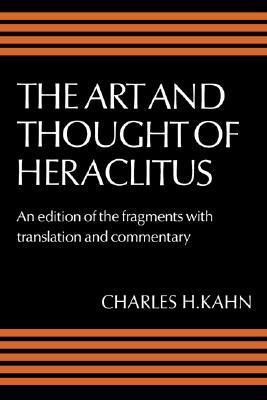
The Art and Thought of Heraclitus
Book Description
Unravel the mysteries of a philosopher who saw the world as a river—ever-changing and full of hidden truths. In "The Art and Thought of Heraclitus," Charles H. Kahn plunges into the profound implications of Heraclitus's ideas on change, unity, and the nature of reality. Explore the tension between opposites and the fire that fuels existence. Witness how his insights resonate through time, influencing thinkers from ancient Greece to the modern world. As the fragments of his thought collide and coalesce, one question lingers: can we embrace the chaos of life, finding meaning in the flux?
Quick Book Summary
"The Art and Thought of Heraclitus" by Charles H. Kahn delves into the complex philosophical landscape crafted by Heraclitus, an early Greek thinker renowned for his assertion that reality is in perpetual flux. Kahn systematically interprets the fragmentary remains of Heraclitus’s writings, shedding light on his concepts of change, unity of opposites, and the underlying logos—a rational principle governing the cosmos. By analyzing the structure and style of Heraclitus's aphorisms, Kahn demonstrates how his enigmatic language mirrors his philosophy of constant change and paradoxical harmony. The book explores Heraclitus’s influence on subsequent philosophical traditions and suggests his ideas remain relevant in modern discussions about reality, identity, and the nature of knowledge. Ultimately, Kahn offers a fresh and accessible lens through which readers can appreciate both the artistry and profundity of Heraclitus’s surviving thoughts.


Summary of Key Ideas
Table of Contents
The Doctrine of Universal Flux and Becoming
Kahn opens his exploration by examining Heraclitus’s doctrine of universal flux, encapsulated in the river metaphor—everything flows and nothing stays the same. He interprets the extant fragments to argue that Heraclitus saw change not as an anomaly but as the fundamental nature of existence. Through a systematic study of language and metaphor in Heraclitus’s writings, Kahn clarifies that becoming and transformation are not merely physical but encompass all aspects of reality, including human life and knowledge. Kahn dispels the myth that Heraclitus’s worldview is one of chaos; instead, he presents a structured cosmos where change is lawlike and meaningful.
The Unity of Opposites and Hidden Harmony
A significant portion of the book focuses on the unity of opposites and the concept of hidden harmony. Heraclitus argues that things which seem opposed are actually interconnected components of a greater unity. Through examples such as day and night or war and peace, Kahn illuminates the subtle logic in Heraclitus’s paradoxes. This perspective challenges rigid dualities and invites readers to perceive underlying continuities in the apparent chaos of the world. Kahn’s analysis reveals how Heraclitus sees balance and justice not as imposed order, but as emergent from the dynamic tension of opposites.
Logos: The Rational Principle Behind Change
Central to Heraclitus’s philosophy is the concept of logos—the rational principle that underlies and orders the cosmos. Kahn dedicates a section to exploring the different interpretations of logos, arguing that it is both a law and a process. He suggests that for Heraclitus, logos is accessible to human reason, yet most people fail to recognize its workings. The logos provides coherence to the ever-changing world, uniting disparate phenomena under an intelligible order. Kahn relates this to the Heraclitean challenge of understanding reality beneath its shifting appearances.
The Role of Fire and Cosmic Order
The image of fire recurs as a symbol of transformation and the cosmic order. Kahn interprets fire as both a physical element and a metaphor for the principle of eternal change. Through close reading of the fragments, he shows how fire unifies destruction and creation, representing the process by which the universe perpetually renews itself. This section emphasizes Heraclitus’s view that the world is not random, but directed by a fiery process that ensures continuity amidst transformation, reinforcing the notion of a cosmos governed by intelligible laws.
Heraclitus’s Influence on Later Thought
Finally, Kahn addresses Heraclitus’s enduring influence and the resonance of his ideas throughout philosophical history. He traces the impact of Heraclitean thought on Plato, the Stoics, and modern philosophers, highlighting debates about reality, perception, and the nature of truth. Kahn concludes that Heraclitus’s insights into change, unity, and the search for order in chaos remain invaluable. The book encourages readers to embrace the flux and complexity of life, finding meaning and coherence where others see only disorder.
Download This Summary
Get a free PDF of this summary instantly — no email required.