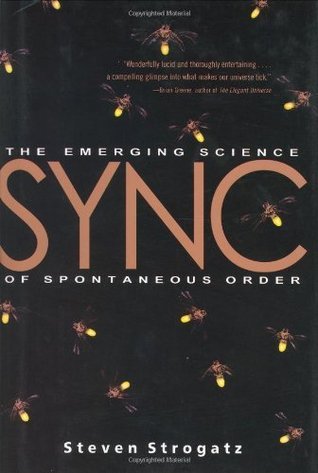
Sync: The Emerging Science of Spontaneous Order
Book Description
Chaos reigns in a world driven by unpredictability, yet beneath the surface, a mesmerizing order stirs. Steven H. Strogatz unveils the astonishing truth of spontaneous order—from the synchronized heartbeat of fireflies to the seamless rhythm of a bustling city. This electrifying exploration reveals how complex systems unite in harmony without a conductor, driven by simple rules that resonate through nature and human society alike. As patterns emerge and connections deepen, questions arise: What hidden forces shape our world? Are we mere observers, or active participants in this stunning ballet of existence? Prepare to see life through a new lens.
Quick Book Summary
"Sync: The Emerging Science of Spontaneous Order" by Steven H. Strogatz is a captivating journey into the phenomenon of synchronization in nature and society. Strogatz explores how order emerges spontaneously in complex systems without central control, using relatable examples such as fireflies flashing in unison, heart cells beating together, and human crowds coordinating their movements. Through vivid storytelling and accessible science, the author explains the mathematical underpinnings of synchronization, reveals the delicate interplay between chaos and order, and showcases the universal nature of this phenomenon. The book not only demystifies the science behind synchronization but also prompts readers to reflect on the hidden harmonies that connect living organisms, physical systems, and even social structures.


Summary of Key Ideas
Table of Contents
Synchronization in Nature and Society
Strogatz begins by detailing mind-boggling examples of synchronization found throughout nature and human culture. He discusses how thousands of fireflies flash in perfect harmony, heart pacemaker cells keep a steady rhythm, and crickets chirp with astonishing unanimity. In human systems, the spontaneous coordination of clapping in concert halls or traffic flow on highways reveals that synchronization transcends biology, surfacing across many contexts. These striking everyday occurrences draw readers into the deeper scientific questions of why and how these collective behaviors arise seemingly without central direction.
Mathematics of Spontaneous Order
Diving into the underlying mathematics, Strogatz introduces the concept of coupled oscillators—entities that, when interacting, tend to align their cycles over time. He explains the foundational Kuramoto model, highlighting how simple mathematical rules can produce highly organized group behavior. The narrative bridges the gap between abstract equations and real-life phenomena, demonstrating how mathematics captures the essence of synchrony, from neural firing patterns in the brain to rhythmic applause in theaters. Strogatz makes even complex concepts approachable, showing how subtle tweaks in connectivity or phase differences can dramatically affect overall synchronization.
From Chaos to Harmony
The book explores the tension between chaos and order, illustrating how both randomness and regularity coexist in synchronized systems. Strogatz examines how initial disorder can give way to steady rhythms, and how synchronized behavior sometimes breaks down, leading to abrupt transitions or cascading failures. Examples span biological systems, like the onset of coordinated cardiac rhythms, to technological and societal networks, such as faulty power grids. The author emphasizes the dynamic, sometimes fragile balance on which synchrony depends, and how systems can tip unpredictably from coherent order to sporadic chaos.
Networks and Universal Patterns
Strogatz extends the discussion to networks, revealing how the connections between components—whether fireflies, neurons, or humans—influence the emergence and resilience of synchrony. He analyzes how local interactions scale up to produce global order, uncovering universal principles that apply across disciplines. The topology of networks—how elements are linked—affects the speed and stability of synchronization. This universality opens windows into understanding everything from epidemics to the internet, revealing deep parallels between seemingly disparate systems.
Implications for Science and Philosophy
The book concludes by reflecting on the broader significance of synchronization in science and philosophy. Strogatz highlights how recognizing spontaneous order reshapes our perspective on the natural world, suggests new avenues for technological innovation, and even prompts ethical inquiries about our participation in collective phenomena. By illuminating the hidden harmonies that shape reality, "Sync" inspires readers to appreciate the interconnectedness of life and the elegant simplicity underlying complex behavior. The story of synchrony ultimately encourages a deeper inquiry into the forces that unite diverse systems in a seamless, often beautiful, dance.
Download This Summary
Get a free PDF of this summary instantly — no email required.