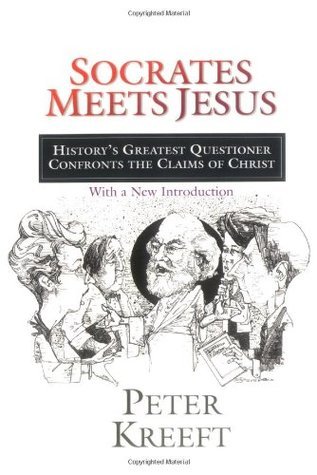
Socrates Meets Jesus: History's Greatest Questioner Confronts the Claims of Christ
Book Description
What happens when a relentless questioner meets the embodiment of faith? In "Socrates Meets Jesus," philosophy collides with divine revelation as Socrates, the master of inquiry, engages in a profound dialogue with Jesus Christ. Unpacking the essence of love, truth, and existence, this gripping exploration reveals the tension between reason and belief. With every turn of the page, readers are drawn into a powerful clash of ideas that challenges the very foundation of faith and reason. Can the greatest philosopher reconcile his quest for truth with the claims of the Savior? Or will the search for answers lead to more profound mysteries?
Quick Book Summary
"Socrates Meets Jesus" by Peter Kreeft imagines an intellectual encounter between Socrates, the probing philosopher, and Jesus Christ, embodying the truths of Christianity. Through a Socratic dialogue, Socrates investigates the central claims of Jesus, scrutinizing faith, revelation, truth, and love. The narrative is set in a modern college setting, where Socrates challenges students and faculty to rethink the assumptions behind belief and skepticism. As Socrates delves into Christian teachings, he raises timeless questions about reason versus revelation, confronting the mysteries of divine nature, salvation, and human purpose. The book skillfully weaves together philosophy and theology, inviting readers to grapple with the rational and existential implications of Christ's message, ultimately seeking whether faith can withstand relentless questioning or if reason itself leads to faith.


Summary of Key Ideas
Table of Contents
The Limits and Power of Reason
The narrative frames Socrates as a visitor at the fictional "Have It Divinity School" in contemporary America. He encounters students, professors, and ultimately the claims of Jesus, sparking a spirited Socratic dialogue. His probing questions, humor, and relentless pursuit of wisdom force the academic community—and readers—to reexamine assumptions about faith, skepticism, and the quest for truth. Socrates’s outsider perspective brings clarity, exposing the gap between abstract philosophical frameworks and the lived reality of faith, and sets the stage for his confrontation with Christ's teachings.
Faith and Divine Revelation
At the heart of the dialogue is the tension between reason and revelation. Socrates, ever the rationalist, presses for proofs and logical consistency, examining biblical narratives and Christian doctrines. He confronts the paradox of God made man, the concept of the Trinity, and the problem of evil, seeking rational explanations. However, Socrates gradually sees the limits of reason: some truths, especially about the divine, may lie beyond logic’s grasp. This challenges not only his own worldview but also the modern assumption that reason alone can lead to ultimate answers.
The Nature of Truth and Love
Central to the book is the exploration of what constitutes truth and love. Socrates investigates not only the logical structure of Christian teaching but also its claims about love as the highest virtue. He compares philosophical definitions of love with those lived and taught by Jesus, finding a radical depth that transcends mere ethics or sentiment. This comparison highlights both the uniqueness of Christ’s message and the insufficiency of secular or purely rational definitions of ultimate values.
Challenging Modern Skepticism
Socrates’s dialogues with students and faculty critique contemporary secularism and relativism. He exposes modern skepticism’s limitations, questioning whether skepticism itself can answer life’s deepest questions or provide meaning. By bringing Socratic rigor to the claims of Christianity, Kreeft allows the reader to witness both the power and perils of questioning without belief, suggesting that relentless doubt can lead to cynicism rather than clarity.
The Search for Meaning and Salvation
The climax of the narrative presents the existential challenge: Can human beings find meaning and salvation through reason alone, or must they ultimately encounter something beyond it? As Socrates engages with Jesus’ claims—especially the offer of salvation, forgiveness, and eternal life—he must decide whether to submit to faith or remain outside its embrace. The story ends not with simple answers but with an invitation to fearless inquiry and honest openness to mystery, encouraging readers to explore the intersection of faith and reason for themselves.
Download This Summary
Get a free PDF of this summary instantly — no email required.