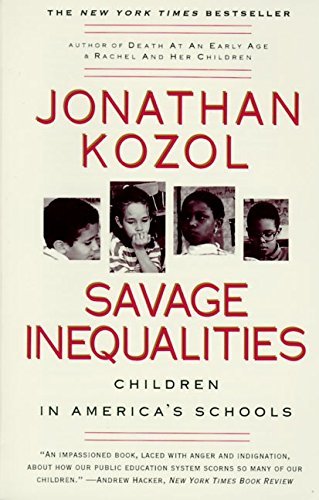
Savage Inequalities: Children in America's Schools
Book Description
Imagine walking into a school where crumbling walls contrast sharply with the bright dreams of its students. This is the stark reality captured in "Savage Inequalities: Children in America's Schools" by Jonathan Kozol, a searing exploration of the devastating disparities in the American education system. Witness the heart-wrenching stories of children trapped in underfunded schools, where hope battles against overwhelming odds. Each page reveals the shocking statistics and personal accounts that expose a fractured society. How can a nation built on the promise of opportunity allow such deep divides in its classrooms?
Quick Book Summary
Jonathan Kozol's "Savage Inequalities: Children in America's Schools" is a powerful exposé of the dramatic differences between schools in affluent and impoverished areas throughout the United States. Drawing on firsthand observations and interviews during the late 1980s, Kozol reveals how systemic inequality, rooted in racial and economic segregation, creates an education system where children in poor, primarily minority communities lack the basic resources available to their wealthier, often white peers. The book brings these injustices to life through vivid descriptions of crumbling school buildings, overcrowded classrooms, and students' personal struggles and aspirations. By confronting the enduring legacy of discrimination and the consequences of funding policies tied to local property taxes, Kozol challenges readers to reflect on the moral implications of a society that allows such stark disparities to persist.


Summary of Key Ideas
Table of Contents
The Impact of Funding Inequality on Educational Opportunity
Kozol begins by documenting the realities of underfunded urban schools, contrasting their dilapidated infrastructure and worrisome conditions with the often lavish facilities in wealthier, predominantly white suburbs. Through visits to schools in cities such as East St. Louis, Chicago, and New York, he exposes how systemic disinvestment manifests as overcrowded classrooms, inadequate supplies, and insufficient support services for students and teachers. These physical inequalities directly impact students’ ability to learn, hampering both academic and emotional growth.
The Persistence of Racial and Economic Segregation
Central to Kozol's analysis is the role of race and class in perpetuating educational disparities. He reveals how local property taxes, the principal source of school funding, both reflect and reinforce deeply entrenched patterns of segregation. Predominantly minority schools, situated in impoverished neighborhoods, receive fewer resources than their suburban counterparts. Kozol argues that this is not merely a product of economic differences, but the result of historical and current policies that uphold racial and social stratification.
Personal Stories from America’s Divided Schools
The book's power lies in its personal accounts: Kozol listens to children, parents, and educators whose daily experiences are shaped by these savage inequalities. He shares stories of students who dream of becoming doctors or artists, despite lacking even the most basic textbooks or safe classroom environments. These narratives highlight not only the deprivation faced by marginalized communities, but also the persistence, hope, and dignity of those struggling within a fundamentally unequal system.
The Political and Moral Failings Behind Educational Disparities
Kozol situates these injustices within a broader political and moral framework. He criticizes policy-makers who justify funding disparities with claims of "local control" and critiques society’s willingness to ignore the suffering of certain children. The book contends that these educational gaps are a national failure, representing a broader unwillingness to confront racism and classism in American institutions. Kozol challenges both leaders and citizens to recognize and address the moral bankruptcy inherent in such a divided system.
Visions for Reform and Social Justice
In concluding, Kozol does not offer simple solutions but instead calls for a profound transformation in public will and policy. He advocates for equitable funding, integration, and a renewed commitment to social justice, insisting that meaningful reform must begin with acknowledging the humanity of every child. "Savage Inequalities" ultimately asks readers to imagine—and work toward—a future where quality education is a true right, not a privilege, sparking ongoing debates about fairness, opportunity, and the American dream.
Download This Summary
Get a free PDF of this summary instantly — no email required.