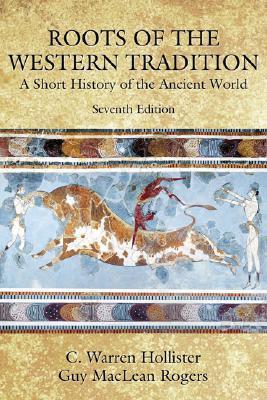
Roots of the Western Tradition : A Short History of the Ancient World
Book Description
Uncover the tumultuous epic that forged the foundations of Western civilization. "Roots of the Western Tradition" delves deep into the ancient world, revealing the triumphs and tragedies that shaped cultures and ideas still felt today. From the rise of city-states to the philosophical clashes that ignited revolutions, this riveting journey captures the struggles for power, belief, and identity that resonate through the ages. With each turn of the page, revel in the drama of humanity's greatest milestones. What unseen threads connect the past to our present, and how will they shape our future?
Quick Book Summary
"Roots of the Western Tradition" by C. Warren Hollister offers a sweeping account of the ancient world's influence on Western civilization. Tracing pivotal events from the earliest Mesopotamian societies, the book explores the emergence of political systems, the birth of philosophical inquiry, and the profound impact of religion and art. Hollister reveals how city-states like Athens and Rome navigated challenges of governance, war, and social change, crafting legacies that shape modern thought and institutions. By delving into the interconnectedness of cultures and ideas, Hollister demonstrates the ongoing relevance of ancient triumphs and tragedies. The book serves as a compelling reminder of how foundational moments in the ancient world continue to influence contemporary society, inviting readers to reflect on the enduring threads between past and present.




Summary of Key Ideas
Table of Contents
Formation of Early Civilizations and City-States
The book begins by examining the origins of civilization in the ancient Near East, focusing on how agricultural developments and the rise of city-states like Sumer and Babylon laid the groundwork for organized societies. Hollister highlights the emergence of administrative systems and laws, such as Hammurabi’s Code, which established frameworks for governance and justice that influenced subsequent cultures. This foundational period also witnessed crucial technological and written advancements, enabling these societies to record and transmit their achievements across generations.
The Birth of Democratic and Political Ideals
Expanding westward, Hollister details the rise of the Greek city-states. He emphasizes the invention of democracy in Athens, the competitive spirit of the polis, and the impact of conflicts such as the Persian Wars and the Peloponnesian War. These struggles produced debates on freedom, citizenship, and the nature of the good life. Greek thinkers like Socrates, Plato, and Aristotle profoundly shaped modes of inquiry, introducing rational analysis and debate that became central to Western intellectual life.
Intellectual Currents and Cultural Exchanges
Attention then shifts to the formation and evolution of the Roman Republic and Empire. Hollister describes Rome’s adaptation of Greek ideas, its legal innovations, and its expansion across Europe and the Mediterranean. The Republic’s political experiments and the Empire’s vast bureaucracy illustrated both the possibilities and the perils of ambitious state-building. Rome’s multicultural environment fostered religious syncretism and architectural achievements, while its eventual decline signaled the challenges inherent in governing diversity and scale.
Religion, Myth, and Art as Unifying Forces
A pivotal theme across the narrative is the central role of religion, myth, and art in shaping social cohesion and identity. From the pantheons of Mesopotamia and Greece to the spread of Christianity under Rome, spiritual and artistic traditions provided meaning and unity in changing times. Hollister traces the evolution of mythology, storytelling, and visual arts as mechanisms for expressing collective values and connecting generations, explaining their enduring power in Western culture.
Legacy and Influence of the Ancient World
In closing, Hollister underscores the deep legacies bequeathed by ancient societies to the West, particularly in systems of governance, legal traditions, philosophical thought, and artistic expression. The ancient world’s continuing influence is presented as both a source of inspiration and a set of unresolved questions. Through analyzing the past’s complex realities—including triumph and tragedy—the book encourages reflection on how the roots of Western tradition inform modern identity, political struggles, and the continual shaping of our future.
Download This Summary
Get a free PDF of this summary instantly — no email required.