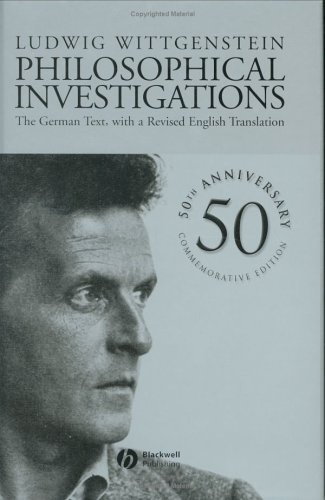
Philosophical Investigations
Book Description
Words can create worlds—but can they also trap us? In "Philosophical Investigations," Ludwig Wittgenstein invites readers into a labyrinth of language, where the clarity we seek becomes elusive and tangled. As he dismantles traditional concepts of meaning, he exposes the vulnerabilities of human understanding and communication. Each page unfolds like a tense dialogue, where assumptions clash with reality, and the stakes are nothing less than our grasp on truth itself. Can we ever truly comprehend the unspoken, or are we forever lost in translation? Grab hold of this intellectual rollercoaster and confront the boundaries of thought.
Quick Book Summary
"Philosophical Investigations" by Ludwig Wittgenstein is a groundbreaking work that challenges the foundations of language and meaning. Moving away from rigid definitions, Wittgenstein proposes that the meaning of words is determined by their use within specific "language games"—contexts shaped by human activities, intentions, and social practices. Through a series of probing remarks and thought experiments, he unveils the complexity of ordinary language and points out the pitfalls of seeking absolute clarity or fixed meanings in philosophical problems. Wittgenstein shows that our understanding often falters when we ignore the nuanced, flexible nature of language. By exposing how philosophical confusions often arise from misapplications of language, the book invites readers to rethink how we communicate, question assumptions, and embrace the open-ended, communal aspects of meaning-making.



Summary of Key Ideas
Table of Contents
Language Games and Meaning as Use
Wittgenstein introduces the concept of language games to illustrate how language derives its meaning from the specific contexts and activities in which it is used. Instead of viewing words as having fixed definitions, he suggests that their significance is embedded in patterns of practice and interaction. Everyday language is flexible, shaped by shared forms of life, and meaning emerges through participation in varied linguistic customs, such as giving orders, asking questions, or making promises. This new perspective shifts focus from abstract definitions to practical engagement.
The Limits of Private Language
A central critique in the book is Wittgenstein’s argument against the possibility of a purely private language—a language inherently understandable by only one person. He shows that meaning is inherently public and social because understanding requires criteria and standards that are shared and recognised by a community. Attempts to invent a language for one’s private sensations (like pain) break down, as language necessitates public rules and agreements.
Rule-Following and Community
Exploring how rules guide meaning, Wittgenstein demonstrates that following a rule is not a matter of rigid interpretation but participation in a tacit practice upheld by communal agreement. Rules themselves do not determine their applications exhaustively; rather, they function within a backdrop of customary usage and social acceptance. This challenges the notion that philosophical clarity can be attained by uncovering foundational rules or definitions, as understanding always depends on active human engagement.
Family Resemblance and Category Boundaries
Wittgenstein introduces the idea of family resemblance to explain how words and concepts form overlapping networks of similarities, rather than sharing a single essence. Categories such as “game” or “language” lack strict boundaries; instead, they connect through a web of related features. This undermines the search for necessary and sufficient conditions in philosophy and reveals how confusion often arises when we overlook the flexible, overlapping nature of concepts.
Therapeutic Approach to Philosophy
Through this investigation, Wittgenstein advocates for a therapeutic approach to philosophy that seeks to dissolve confusion rather than construct grand theories. By examining the ordinary uses of language, he shows how philosophical problems often arise when language is wrested from its normal context. The goal is not to solve metaphysical riddles but to untangle linguistic knots, clarify practices, and restore us to the everyday workings of language, where meaning is found in the shared, practical activity of life.
Download This Summary
Get a free PDF of this summary instantly — no email required.