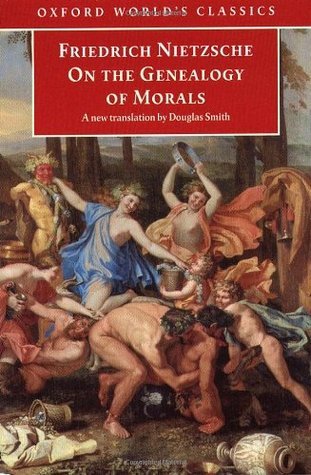
On the Genealogy of Morals
Book Description
What if the very foundations of morality were built on a web of hidden intentions and power struggles? Friedrich Nietzsche peels back the layers of societal values in "On the Genealogy of Morals," exposing the chilling truth behind concepts like guilt, responsibility, and the ascetic ideal. This riveting exploration dissects the historical roots of our ethical beliefs, questioning their legitimacy and challenging readers to confront uncomfortable truths about humanity's darker instincts. With every page, Nietzsche ignites a fierce debate on the nature of good and evil. Is morality a noble ideal or a tool of manipulation?
Quick Book Summary
"On the Genealogy of Morals" by Friedrich Nietzsche is a probing critique of the origins and development of Western morality. Nietzsche questions whether our concepts of good and evil are absolute or historically contingent, scrutinizing their emergence from societal power dynamics, religious institutions, and psychological drives. Through three essays, he examines the shift from noble, life-affirming values to a morality rooted in resentment, instigated by the oppressed classes—chiefly through the influence of Christianity. Nietzsche unpacks how guilt and ascetic ideals become instruments of control, restraining human potential and vitality. He invites readers to confront the uncomfortable possibility that much of what is called “morality” may serve self-interested purposes, urging a re-evaluation of values in pursuit of life’s affirmation and creative freedom.




Summary of Key Ideas
Table of Contents
The Origin and Evolution of Morality
Nietzsche opens his exploration by challenging the accepted value of our moral concepts, questioning whether notions like "good" and "evil" have immutable meanings or are products of historical and social development. He argues that morality is not divinely ordained but instead constructed through evolving cultural, psychological, and power relations. Early forms of morality, Nietzsche suggests, stem from the strong and noble defining themselves as "good," and those unlike them as "bad," with these judgments tied to actions and personal excellence.
Master-Slave Morality and the Role of Ressentiment
This order is upended with the birth of what Nietzsche calls "slave morality," which arises from the resentment (ressentiment) of the oppressed. Here, the weak reframe their powerlessness as virtue, condemning their oppressors as "evil" and their own qualities as "good." This reversal is epitomized by Christianity, which Nietzsche sees as celebrating humility, meekness, and suffering, ultimately turning the values of the powerful upside down. The psychological mechanism behind this is ressentiment, a deep-seated, festering anger transformed into moral judgment.
The Construction of Guilt and Bad Conscience
Nietzsche then turns to the genesis of guilt and the “bad conscience.” He argues that as societies stabilize and internalize their laws, individuals turn outwardly enforced discipline into inward self-punishment—thus guilt originates from the debtor-creditor relationship. The concept of guilt, once a practical matter of compensation, becomes internalized and moralized, creating a source of psychological torment. This "bad conscience" becomes fertile ground for religious exploitation, especially by priestly castes.
The Power and Danger of the Ascetic Ideal
Central to Nietzsche’s diagnosis is the ascetic ideal, which promotes self-denial, the suppression of desires, and anti-life tendencies. Asceticism, valorized by Christianity and other philosophical traditions, diverts the will to power away from worldly flourishing and self-overcoming, toward self-negation and suffering as ultimate values. Nietzsche criticizes the ascetic ideal as life-denying, a tool for both the weak and the priestly class to gain influence by turning vitality and creative energy against itself. He contends that this ideal serves as a coping mechanism for dealing with existential suffering when meaningful self-expression is blocked.
Through his historical and psychological critique, Nietzsche lays bare the contingent, constructed nature of moral values. He warns that clinging to inherited moral systems hampers human flourishing and honest self-examination. Nietzsche urges his readers to revalue all values, to recognize the role of power and psychological drives in morality, and ultimately to embrace more life-affirming paths. His challenge is subversive and enduring, inviting society to question the legitimacy and necessity of its moral edifices in pursuit of a truer, richer existence.
Download This Summary
Get a free PDF of this summary instantly — no email required.