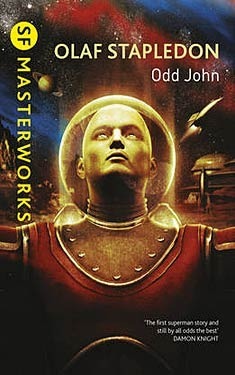
Odd John
Book Description
A superhuman child emerges from the shadows, challenging humanity's very essence. Odd John navigates a world that fears his extraordinary intellect and alien consciousness, forging a path of isolation and defiance. As he grapples with profound abilities and a longing for connection, he must confront a society unprepared for his vision of evolution. Tension mounts as he assembles a group of like-minded outcasts, igniting a battle between acceptance and fear. With each twist, the stakes rise higher. Can Odd John reshape humanity’s destiny, or will he be doomed to remain an outsider forever? What happens when evolution itself becomes a weapon?
Quick Book Summary
"Odd John" by Olaf Stapledon is a groundbreaking science fiction classic that tells the story of John Wainwright, a superhuman child whose intellect and abilities far exceed those of ordinary humans. Born with remarkable physical and mental attributes, John quickly recognizes his otherness, both fascinating and alienating those around him. As he grows, John seeks to understand his place in a world that cannot comprehend his vision or potential. Gathering others like himself, he aims to establish a new society, challenging conventional morality and humanity’s evolutionary trajectory. Stapledon explores deep philosophical questions about the meaning of intelligence, the future of human evolution, and the price of remaining an outsider. The novel ultimately presents a poignant meditation on what happens when the next step in evolution confronts an unready species.


Summary of Key Ideas
Table of Contents
Superhuman Intelligence and Alienation
The novel begins with the birth of John Wainwright, whose strangeness and precocity quickly set him apart. Unlike ordinary children, Odd John displays superhuman intellect, physical capabilities, and emotional detachment. His early years are marked by his mother's protection and society's suspicion, portraying the inherent alienation faced by someone so fundamentally different. The narrative, framed through the perspective of a family friend, documents John's quest to define his identity amid misunderstanding and fear, underscoring the isolation that accompanies extraordinary ability.
The Challenge of Human Evolution
As John matures, his intellectual and ethical development intensifies. He rapidly absorbs knowledge, becoming aware of the limitations of human thought and morality. John views himself as a new kind of human—"Homo superior"—and begins to question the values and structures underpinning society. His abilities, from telepathy to advanced scientific understanding, accentuate his estrangement, prompting philosophical debates about what it means to be truly human and whether morality is universal or context-dependent.
Ethics Beyond Humanity
Seeking kinship, John scours the globe for individuals who share his unique traits. He assembles a small community of "supernormals," each of whom possesses their own anomalous abilities and perspectives. Together, they envision a utopian society organized around intellect, cooperation, and evolutionary progress. However, their attempts to distance themselves from the rest of humanity and assert their autonomy inevitably create tension and fear among those they leave behind. These chapters explore both the allure and perils of transcending biological and social boundaries.
Building a New Society
The new society attempts to create ethical frameworks and cultural norms fit for their advanced capacities. Yet, their detachment from the emotions and values of humanity at large leads to profound moral dilemmas, especially when their survival comes into direct conflict with human interests. Odd John and his companions are forced to make difficult choices, including acts that ordinary people would regard as immoral, revealing the complexities of living beyond traditional ethical constraints.
Confrontation with the Ordinary World
Ultimately, the outside world's suspicion turns into open hostility. Society perceives John and his group as threats, culminating in violence and tragedy. The narrative highlights the challenges facing those who push the boundaries of evolution and culture, and the book closes with a poignant meditation on the price of advancement. While Odd John's vision for a new species remains unfulfilled, the novel leaves readers contemplating the future of intelligence, the limits of tolerance, and the fate of outsiders in a world resistant to change.
Download This Summary
Get a free PDF of this summary instantly — no email required.