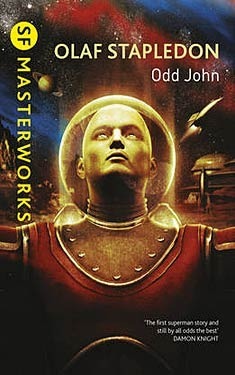
Odd John
Book Description
A superhuman child emerges from the shadows, challenging humanity's very essence. Odd John navigates a world that fears his extraordinary intellect and alien consciousness, forging a path of isolation and defiance. As he grapples with profound abilities and a longing for connection, he must confront a society unprepared for his vision of evolution. Tension mounts as he assembles a group of like-minded outcasts, igniting a battle between acceptance and fear. With each twist, the stakes rise higher. Can Odd John reshape humanity’s destiny, or will he be doomed to remain an outsider forever? What happens when evolution itself becomes a weapon?
Quick Book Summary
Odd John, by Olaf Stapledon, is a visionary science fiction novel that explores what happens when a superhuman being is born into ordinary humanity. John Wainwright, nicknamed Odd John, demonstrates intelligence and abilities far beyond those of his peers from an early age. As he matures, John becomes increasingly alienated from the world, recognizing his fundamental difference from society. He seeks out others like himself and steadily grows into the leader of a small group of 'supernormals', who collectively dream of founding a utopia suitable for their kind. Their efforts lead them to an isolated island where they build a society based on their advanced ideals. However, the world responds with suspicion and hostility. Odd John’s journey is both a reflection on human limitations and an exploration of transcendence, evolution, and the cost of being extraordinary.


Summary of Key Ideas
Table of Contents
The Nature and Isolation of Superhuman Intelligence
Odd John narrates the life of John Wainwright, born to ordinary parents but exhibiting astonishing intellect and abilities from early childhood. His differences isolate him emotionally and socially, as even his family and closest confidants struggle to understand him. John rapidly outpaces the education system and withdraws from conventional society, questioning the values and limitations of the human race. His acute awareness of his uniqueness cultivates a sense of detachment and superiority, prompting him to study and manipulate people as an outsider might examine a foreign species.
Society’s Fear and Rejection of the Unfamiliar
As John grows, he seeks out others who share his exceptional nature, uncovering a hidden network of individuals with advanced capabilities. This search becomes essential to understanding himself, as the longing for kinship and belonging persists despite his intellectual distance from humanity. Eventually, John establishes deep connections with several 'supernormals,' gaining their trust and shaping a vision for the future that could nurture their potential, free from the mediocrity and prejudice of the wider world.
Evolution as a Double-Edged Sword
Recognizing the impossibility of integration, John and his select group embark on a daring project to create a society tailored to their values. They choose a secluded island where they experiment with new forms of governance, ethics, and collective living. Their utopia is marked by intellectual pursuits, communal harmony, and an ambition to advance evolution itself. These experiments in society raise poignant questions about the meaning of progress and the dangers of elitism, as the group struggles with their own internal challenges and moral quandaries.
The Search for Kinship and Utopia
The outside world, however, feels threatened by the isolation and extraordinary abilities of the supernormals. Rumors and fear mount until their island is surrounded and attacked by external powers. John faces the ultimate ethical dilemma: to defend his society by any means necessary or accept their fate in a hostile world. Confronted by humanity’s inescapable suspicion and intolerance, Odd John must decide if transcending humanity is worth the price of perpetual conflict and isolation.
Ethical Dilemmas of Power and Progress
Stapledon's novel ultimately interrogates the boundaries of evolution and the dangers of exceptionalism. Odd John’s story is a meditation on the risks and rewards of human progress, the tragedy of being fundamentally misunderstood, and the fate of those who embody the next step in evolution. Through John’s struggle, the novel challenges readers to confront questions of empathy, acceptance, and the possibility of coexistence between different kinds of intelligence. It leaves us wondering: can true evolution ever flourish in a world that fears what it cannot understand?
Download This Summary
Get a free PDF of this summary instantly — no email required.