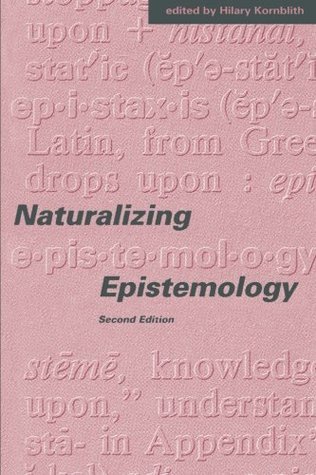
Naturalizing Epistemology
Book Description
What if the very foundation of knowledge is built on the natural world around us? In "Naturalizing Epistemology," Hilary Kornblith takes readers on an exhilarating journey, unraveling the intricate ties between our understanding of knowledge and the empirical realm. With each page, the boundaries between philosophy and science blur, revealing profound implications for how we perceive truth, belief, and reason. Kornblith's provocative insights challenge age-old assumptions, daring to ask: Can we truly know anything without grounding it in nature? This compelling exploration leaves you questioning everything you thought you knew about knowledge—are you ready to confront the truth?
Quick Book Summary
"Naturalizing Epistemology" by Hilary Kornblith revolutionizes the landscape of epistemology by grounding the study of knowledge in empirical science rather than abstract analysis. Kornblith critiques traditional, armchair approaches to epistemology and instead advocates for a methodology that investigates knowledge as a natural phenomenon, subject to scientific exploration. Drawing on examples from psychology, biology, and cognitive science, Kornblith demonstrates how human cognition is a natural process, shaped by evolution and adapted for navigating the real world. He challenges the distinction between facts and norms, suggesting that our concepts of justification and truth should be informed by how minds actually work. By bridging the divide between philosophy and science, Kornblith offers a compelling vision for a more robust and naturalistic epistemology.




Summary of Key Ideas
Table of Contents
Epistemology as a Natural Science
Kornblith begins by questioning the traditional view that epistemology is a uniquely philosophical enterprise conducted from the armchair, reliant on pure reasoning and intuition. He argues that if knowledge is a phenomenon that occurs in the natural world, then the proper study of knowledge should involve empirical investigation. Drawing on the successes of natural sciences, Kornblith recommends treating epistemology much like biology studies life: not through definition and analysis, but through observation and scientific inquiry.
Critique of Traditional Intuition-Driven Methods
A significant portion of the book is dedicated to critiquing the intuition-based methods prevalent in mainstream epistemology. Kornblith suggests that intuition is an unreliable guide to truths about knowledge, as intuitions are themselves products of contingent psychological processes. He contends that philosophical debates that rely solely on intuition end up mired in unresolvable disputes and that real progress requires grounding our analyses in empirical facts about human cognition.
The Role of Evolution in Cognition
Kornblith channels evolutionary theory, proposing that our cognitive faculties are adapted to track and understand features of the natural world. Knowledge, then, is not just a matter of meeting some idealized standard, but a biologically functional capacity. By understanding how evolution has shaped the ways we come to form reliable beliefs about our environment, we can better understand both the strengths and limitations of human knowledge.
Reframing Justification and Truth
Central to Kornblith’s argument is a reexamination of the concepts of justification and truth. He argues that these should not be fixed by abstract theorizing, but rather informed by the empirical realities of cognitive processes. Justification becomes a question of how reliable belief-forming practices actually are—not how they appear in intuition or philosophical models. This reconceptualization seeks to close the gap between normative and descriptive accounts of knowledge.
Interplay Between Philosophy and Empirical Science
Ultimately, Kornblith envisions a collaborative relationship between philosophy and the empirical sciences, where epistemology is revitalized by the rigor and discoveries of psychology, neuroscience, and cognitive science. He maintains that a naturalized epistemology does not reject traditional philosophical concerns, but rather addresses them on firmer, scientifically-informed ground. In doing so, Kornblith’s approach offers a provocative and sustainable framework for understanding knowledge in a contemporary context.
Download This Summary
Get a free PDF of this summary instantly — no email required.