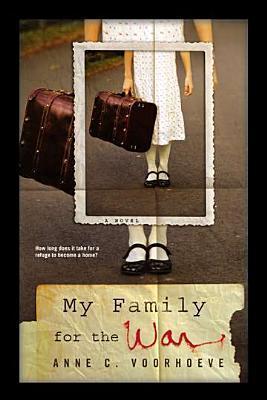
My Family for the War
Book Description
A war is raging, and for a Jewish girl in Nazi-occupied Amsterdam, survival means leaving everything behind. As she navigates the perilous landscape of betrayal and loss, friendships shimmer in the shadows, and hope flickers in unlikely places. With each tense moment, she learns that family can take many forms, and love can blossom even in the darkest of times. Secrets whisper through hidden corridors, and danger lurks at every turn. Can she hold onto her dreams while the world crumbles around her? In a fight for identity and connection, what will she sacrifice for the sake of those she holds dear?
Quick Book Summary
"My Family for the War" by Anne C. Voorhoeve follows Ziska (Franziska) Mangold, a young girl whose life is turned upside down by the onset of World War II. Born to a non-practicing Jewish family in Berlin, Ziska escapes Nazi Germany via the Kindertransport to London just before the war erupts. Alone in a foreign land, she grapples with a new identity as she’s placed with a foster family, the Shepards, who are Orthodox Jews. Torn between loyalty to her upbringing and her growing connection to her new guardians, Ziska navigates heartbreak, displacement, and the search for belonging. The novel explores the resilience needed to survive, the redefinition of family, and the enduring hope found in human connection during times of immense upheaval.




Summary of Key Ideas
Table of Contents
Redefining Family and Belonging
The journey of Ziska Mangold begins in Berlin during the escalating dangers of Nazi rule. Her Jewish ancestry—though secular—marks her as a target, and her parents make the agonizing decision to send her to safety through the Kindertransport. Arriving in London, Ziska is thrust into a world foreign in language, customs, and faith. This emotional upheaval initiates her search for a sense of belonging and a new identity—one not solely tied to her biological parents or her previous life.
Loss, Identity, and Transformation
Placed with the Shepard family, who are deeply rooted in Orthodox Judaism, Ziska experiences a dramatic cultural shift. The Shepards welcome her with warmth and structure, introducing her to religious traditions long absent from her secular German upbringing. As she adapts, Ziska oscillates between her past and present, feeling both loyalty to her birth family and affinity for the Shepards. This tension illuminates the nuanced ways family can be constructed through love, care, and shared hardship, rather than blood alone.
The Courage of Ordinary People
Throughout her journey, Ziska witnesses the courage of those around her. The caregivers, friends, and strangers she encounters display small but powerful acts of defiance and compassion—whether through providing shelter, offering friendship, or simply standing by her during moments of vulnerability. These acts of ordinary heroism enable Ziska and countless other refugee children to survive emotionally as well as physically, and highlight the impact individuals can have within the vast sweep of history.
Survival and the Kindertransport
The book addresses the trauma and longing that come with forced separation. Ziska contends with survivor's guilt, strained correspondence with her parents, and the uncertainty of reunion. She finds solace and connection through enduring friendships with other refugee children and the evolving bond with her foster family. The story also examines the shifting sense of self that arises from living in exile, as Ziska’s identity is shaped by her circumstances, and she learns the importance of preserving memories while adapting to new realities.
The Endurance of Hope and Friendship
Ultimately, "My Family for the War" is a testament to hope’s persistence. In the bleakness of war and displacement, small gestures—shared meals, acts of kindness, the steady glow of Shabbat candles—become lifelines. Ziska’s journey is not just about survival, but about the possibility of renewal and the formation of new connections. The novel reveals that even as the world falls apart, family and love can be found, lost, and remade in unexpected ways.
Download This Summary
Get a free PDF of this summary instantly — no email required.