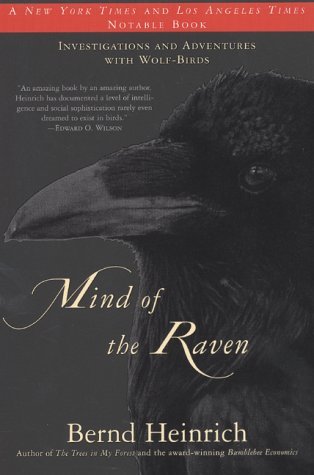
Mind of the Raven
Book Description
What if the mind of a raven holds secrets of the universe? In 'Mind of the Raven,' Bernd Heinrich plunges into the enigmatic world of these black-feathered birds, revealing their astonishing intelligence and complex behaviors. Through vivid storytelling and breathtaking observations, Heinrich invites readers to witness the raven’s extraordinary problem-solving skills, intricate social dynamics, and deep emotional connections. Each page uncovers a new layer of understanding, challenging the way we see nature's most misunderstood creatures. Prepare to be captivated by the mystery: what truths about life and consciousness lie hidden in the shadows of the raven's gaze?
Quick Book Summary
"Mind of the Raven" by Bernd Heinrich is an immersive exploration of the intelligence, social complexity, and remarkable adaptability of ravens. Drawing from years of field research and personal encounters, Heinrich provides an intimate look into the thought processes and emotional lives of ravens. He highlights their ability to solve problems, communicate, and form unique social bonds, dispelling myths about these birds as mere symbols of darkness. Through storytelling and close scientific observation, the author reveals how ravens display cognitive qualities once believed to be uniquely human. Ultimately, Heinrich invites readers to reconsider what it means to possess a mind, blending natural history, personal passion, and scientific insight to paint a portrait of ravens as sentient and fascinating creatures.




Summary of Key Ideas
Table of Contents
Raven Intelligence and Problem-Solving
Bernd Heinrich embarks on a captivating investigation into the intelligence of ravens, focusing on their problem-solving skills and cognitive abilities. Through meticulously designed experiments and observations, he demonstrates that ravens can reason, anticipate outcomes, and use tools, challenging assumptions about bird brains. Ravens employ ingenious strategies to obtain food and communicate information, displaying a level of adaptability and forethought that rivals many mammals. These findings suggest that intelligence is not the exclusive province of humans and our closest relatives, but can evolve independently in distant animal lineages.
Social Structures and Communication
The book delves deeply into the social world of ravens, illustrating that these birds live within rich networks of relationships. Heinrich observes alliances, rivalries, and even play among ravens, noting how individuals recognize each other and remember past interactions—responses indicative of complex social intelligence. Their elaborate vocalizations and body language enable intricate communication, from warning calls to invitations for cooperation, highlighting the sophistication of their communal lives. Social bonds and hierarchies influence their interactions, affecting resource sharing and group survival.
Emotional Lives and Individuality
Beyond cognitive and social prowess, Heinrich presents compelling evidence for the emotional depth of ravens. He recounts episodes hinting at joy, empathy, and even grief, suggesting a nuanced inner life. Ravens form attachments not only with each other but, at times, with humans, demonstrating curiosity and affection. Their personalities vary, with some birds showing boldness and others caution. This individuality adds another layer to understanding raven minds, challenging simplistic views of nonhuman animals as mere biological automatons.
Human-Raven Interactions and Cultural Perceptions
Heinrich weaves narratives of his encounters and experiments with cultural reflections, examining the often ambivalent relationship between humans and ravens. Historically, ravens have occupied symbolic roles as tricksters, omens, or messengers in myth and folklore. Through his respectful, scientifically rigorous engagement, Heinrich seeks to dissolve the fear and misunderstanding that have long shrouded the species. He emphasizes how shared curiosity and learned mutual respect can dismantle barriers between observer and subject, enhancing our appreciation for nature’s complexity.
Implications for Understanding Animal Minds
Ultimately, "Mind of the Raven" poses profound questions about the nature of consciousness and the boundaries of animal minds. Heinrich’s investigations make a compelling case for the continuity of cognitive and emotional traits across species, suggesting that the ravens’ behavior is not alien but resonant with our own. His work encourages a shift in perspective—from viewing ravens as mysterious outsiders to recognizing them as sentient beings with lives as intricate and meaningful as ours. The book is both a scientific achievement and a philosophical meditation on perception, intelligence, and the shared mysteries of life.
Download This Summary
Get a free PDF of this summary instantly — no email required.