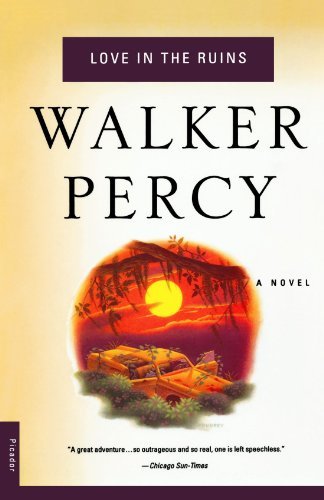
Love in the Ruins
Book Description
Amid a world crumbling under the weight of modernity and despair, one man finds himself caught in a whirlwind of love, loss, and existential crisis. Dr. Tom More, a psychiatrist with a fractured mind and an unsteady grip on reality, navigates a city teetering on the edge of chaos. As he juggles his troubled patients with his own turbulent relationships, every choice could spell salvation or doom. Can love triumph in a landscape riddled with moral decay? Or will the ruins of heartbreak consume him before he can find redemption? What would you sacrifice to save the world—and yourself?
Quick Book Summary
Set in an America deeply fractured by political extremism and societal malaise, "Love in the Ruins" follows Dr. Tom More, a psychiatrist and lapsed Catholic, as he navigates personal and collective crisis. Living on the outskirts of a decaying Southern town, Tom invents the Ontological Lapsometer, a device that diagnoses spiritual and mental maladies. The country teeters on the brink of collapse, mirrored by Tom's inner turmoil and complex romantic entanglements. As he attempts to heal others and himself, he confronts questions of faith, love, and the persistence of goodness amid chaos. Satirical and philosophical, the novel explores the possibility of redemption and connection in a world splintering under modern pressures.


Summary of Key Ideas
Table of Contents
Societal Fragmentation and Satire
"Love in the Ruins" takes place in a near-future America where divisions along racial, political, and social lines have deepened into violence and entropy. The small Louisiana town where Dr. Tom More lives stands as a microcosm of broader collapse: communities are polarized, institutions have crumbled, and spiritual malaise runs rampant. Percy's satire exaggerates the absurdities of modern ideologies—liberal, conservative, and religious alike—with wit and a critical eye, painting a landscape that is both surreal and eerily familiar. The world's disorder echoes the psychological struggles of its inhabitants, blurring the distinction between outer and inner chaos.
The Search for Meaning and Faith
At the heart of the novel is Tom More, a deeply conflicted man wrestling with his own failures as a husband, father, and Catholic. Haunted by personal loss and medicating with alcohol, Tom's sense of purpose falters until he invents the Ontological Lapsometer, which he believes can diagnose and perhaps cure spiritual maladies. Tom’s journey is not only physical—ducking violence and political extremists—but also existential, as he questions the nature of redemption and whether sanity or faith can withstand a broken world.
Technology as Salvation and Danger
The Ontological Lapsometer becomes a double-edged symbol within the book. Initially envisioned as a tool to heal psychological and spiritual rifts, it is quickly co-opted by government agencies and power brokers who seek to use it for control or profit. The device raises questions about technology's double-edged nature: can scientific progress truly save humanity, or does it risk deepening our divisions and afflictions? Through the Lapsometer, Percy critiques both the promise and peril of trying to rationalize or mechanize the soul’s ailments.
Love, Desire, and Redemption
Intertwined with these grand themes is Tom’s entanglement in love affairs—with Lola, Ellen, and Moira—each representing different facets of desire and hope. These relationships mirror Tom's search for wholeness and the temptations that threaten to derail him. Ultimately, the challenge of love rests not in escape but in reconciliation: with self, with others, and with the remnants of faith that still flicker within him. Tom’s engagements offer the possibility of redemption, even as they expose his vulnerabilities and moral lapses.
In the end, Percy suggests that genuine connection—through love, forgiveness, and perhaps a rediscovered faith—remains possible in the ruins. The novel closes ambiguously, with Tom and those he cares about surviving the worst of the chaos, yet facing an uncertain future. Hope is fragile, just as civilization and sanity are, but it persists. “Love in the Ruins” challenges readers to see through satire the deeper questions of meaning, offering the possibility that grace may still be found amidst despair.
Download This Summary
Get a free PDF of this summary instantly — no email required.