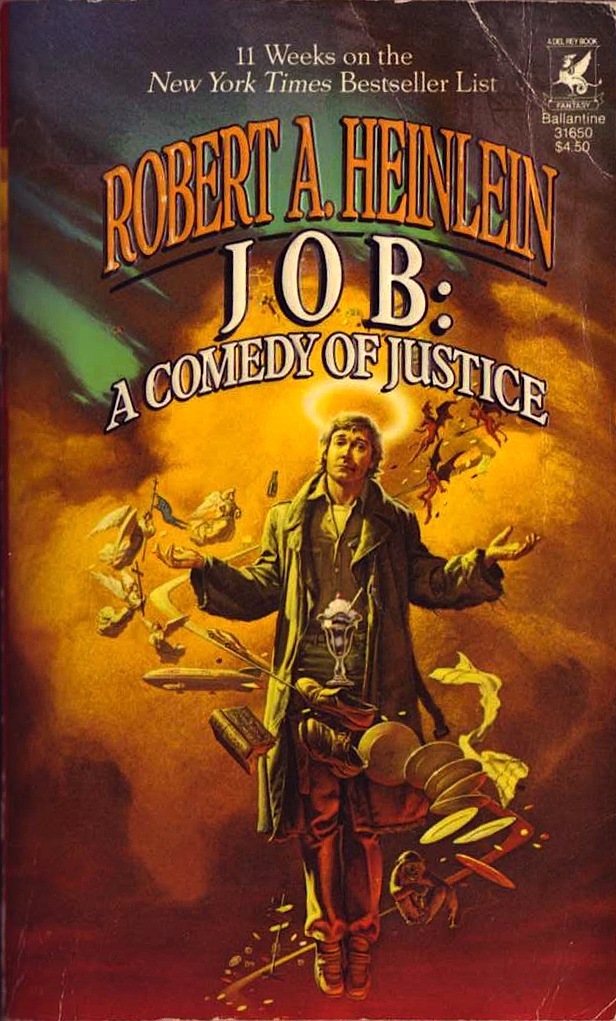
Job: A Comedy of Justice
Book Description
In a world where divine justice is as unpredictable as the whims of fate, a man named universal trotter finds his beliefs challenged when he is swept into an absurd cosmic adventure. Torn between loyalty to his wife and a hidden destiny, he must navigate a landscape filled with gods, moral dilemmas, and unexpected friendships. As he faces strange creatures and surreal trials, the boundaries of reality blur, leading him toward a shocking revelation about truth and justice. With every twist, the stakes grow higher—how far will one man go to prove his faith when the universe itself seems to conspire against him?
Quick Book Summary
"Job: A Comedy of Justice" by Robert A. Heinlein is a satirical and thought-provoking exploration of faith, justice, and the capricious nature of the divine. The story follows Alex Hergensheimer, a Christian minister, who is hurled into a multiverse-spanning adventure alongside his beloved Margrethe. As worlds shift around them—often without warning—Alex confronts bizarre new realities, gods both familiar and strange, and moral challenges that force him to reconsider his deeply held beliefs. Through Heinlein’s trademark wit and imaginative world-building, the novel navigates questions of predestination, love, and the sometimes-absurd architecture of the cosmos, ultimately challenging the boundaries between justice, faith, and cosmic bureaucracy.




Summary of Key Ideas
Table of Contents
The Nature of Divine Justice
The novel opens with Alex Hergensheimer, a self-assured Christian and cruise ship chaplain, experiencing a sudden displacement from his familiar reality. This shift propels him into a succession of alternate worlds, a journey launched by the intervention of Loki, the trickster god. Each transition is jarring: Alex encounters altered histories, mythological elements, and new rules of existence. Early on, he meets Margrethe, a Danish waitress and pagan, whose steadfast presence becomes a grounding force through the chaotic transdimensional odyssey. Together, they face a landscape where the familiar is constantly upended, and where Alex’s religious certainties are challenged at every turn.
Faith Versus Personal Morality
As they leap from one version of reality to another, Alex repeatedly confronts moral and theological dilemmas. The traditional constructs of heaven, hell, and salvation he once believed in prove to be anything but reliable. Heinlein uses Alex’s trials not only for comic effect but to satirize the often contradictory notions of divine justice present in organized religion. Alex’s earnest, sometimes stubborn efforts to maintain faith and make sense of his trials highlight the human tendency to seek meaning, even in the face of cosmic absurdity.
Bureaucracy of the Cosmos
Divine beings, including Loki, Jehovah, and Satan, are depicted as bureaucratic and frequently self-serving, running the affairs of the universe with little compassion for human suffering. The afterlife is portrayed as a complex and sometimes unjust system, undermining the comfort Alex associates with his faith. Bureaucracy abounds in both celestial and infernal hierarchies, poking fun at the idea that salvation can be won through adherence to arbitrary rules. Alex and Margrethe’s attempts to be reunited after death become emblematic of their struggle against a system designed less for justice than perpetuation of its own inefficiencies.
Satire of Religious Beliefs
Amid this cosmic chaos, Margrethe’s unwavering loyalty and open-mindedness stand in sharp contrast to Alex’s dogmatic worldview. Their love story, tested against the backdrop of existential uncertainty, injects heart and humanity into the novel. It is through their relationship that Alex is pushed to reassess not only his spiritual beliefs but his notion of justice itself. Ultimately, love—persistent, sacrificial, and resilient—emerges as the most stable force in a universe ruled by caprice.
Resilience of Love Across Worlds
Heinlein concludes the story with characteristic irreverence and ambiguity. Alex’s journey does not deliver the tidy justice or closure he seeks but leaves him, and the reader, wrestling with the limits of faith and the impenetrability of divine intention. The novel’s blend of humor, fantasy, and social critique ensures its enduring relevance, inviting readers to question, laugh, and perhaps find comfort in the shared absurdity of searching for justice in an unpredictable world.
Download This Summary
Get a free PDF of this summary instantly — no email required.