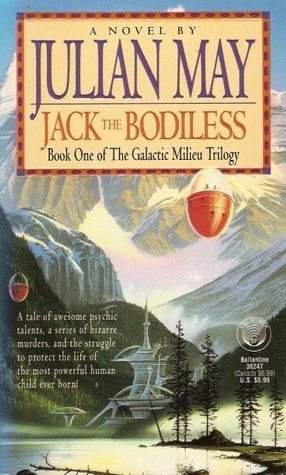
Jack the Bodiless
Book Description
In a world where the line between life and death is blurred, a young man awakens to find himself detached from his physical form, navigating a landscape filled with danger and betrayal. Haunted by his own disembodied existence, Jack must uncover the truth of his transformation while grappling with the bonds that tether him to the living. As he battles sinister forces intent on his destruction, alliances twist, secrets unravel, and an epic struggle for identity unfolds. Can Jack reclaim his body and uncover the dark power that threatens to consume him?
Quick Book Summary
In "Jack the Bodiless" by Julian May, the boundaries between the physical and metaphysical are challenged when Jack, a young man from a powerful psychic family, survives the destruction of his body and continues to exist as a potent disembodied mind. Navigating a future Earth where telepathy and psionic abilities rule, Jack must fight sinister forces hell-bent on exploiting his extraordinary powers. Intrigue, betrayal, and a complex web of alliances define Jack’s journey as he seeks to understand the nature of his existence, reconnect with his family, and prevent a dark conspiracy that threatens humanity. The novel intertwines themes of identity, the struggle for agency, and the evolving nature of human potential in a world shaped by advanced psychic powers.


Summary of Key Ideas
Table of Contents
Disembodied Consciousness and Identity
Set in the late 21st century, "Jack the Bodiless" introduces a future Earth where humanity has developed extraordinary psychic abilities. At the center is Jack Remillard, heir to a potent lineage of telepaths. After a catastrophic accident orchestrated by enemies, Jack’s physical body is destroyed, but his consciousness endures, untethered from flesh—earning him the moniker Jack the Bodiless. The narrative explores the shock, confusion, and terror Jack experiences as he adapts to his new existence and seeks meaning in his non-corporeal state.
Power Struggles in a Psychically-Gifted Society
Without a physical form, Jack navigates a world rife with both opportunity and peril. His psychic powers, now unanchored, become both a gift and a curse, drawing the attention of factions seeking to use him for their own ends. Political intrigue and shadowy conspiracies play out among "Metapsychic" and "non-Metapsychic" factions. Jack grapples with trust, as allies like his family and mentor Marc Remillard become entangled in a high-stakes battle of power, while enemies emerge from the relentless Family Hydra, a group with their own dark designs for humanity and its evolution.
Family, Loyalty, and Betrayal
Family bonds and questions of loyalty and betrayal run through the novel. Jack’s survival and agency depend on his psychic connections to his brother Paul and other members of the Remillard family. Their shared powers and intertwined destinies force them to confront long-standing secrets and past betrayals. Relationships are tested as Jack’s unique condition is alternately viewed as an aberration or a source of hope for the future of Metapsychic humanity.
The Threat of Corruption and Dark Powers
Darkness lurks in both the psychic and political realms. Sinister forces, including the Hydra and corrupt Metapsychics, attempt to manipulate Jack’s powers and exploit the Remillard family schisms. Battles, both subtle and overt, ensue over control of Jack’s abilities and the future direction of human evolution. The nature of power—how it corrupts, redeems, and shapes destiny—provides a backdrop for the interweaving struggles of ideology and ambition.
The Search for Self and Redemption
Ultimately, the novel is Jack’s quest for self-definition and redemption. His journey from confusion and despair to acceptance and agency reflects a broader meditation on what it means to be human—when the mind is unconstrained by flesh, when identity is forged in adversity, and when the ties that bind us to others can be both prison and salvation. As hidden secrets unravel and alliances shift, Jack’s resolution to reclaim his body becomes a powerful metaphor for reclaiming agency and hope in the face of overwhelming adversity.
Download This Summary
Get a free PDF of this summary instantly — no email required.