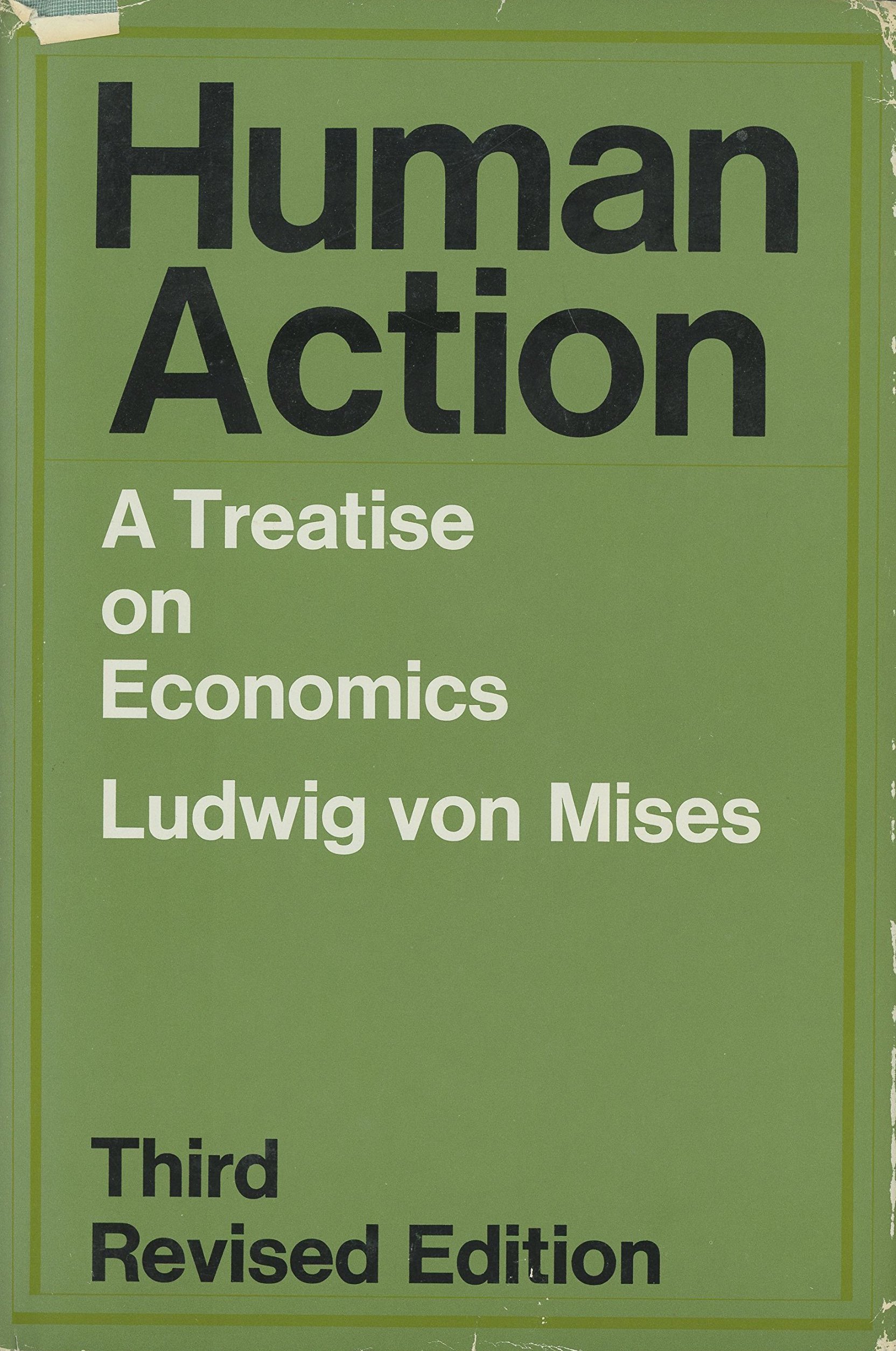
Human Action: A Treatise on Economics
Book Description
In a world where choices shape destinies, "Human Action: A Treatise on Economics" unveils the intricate dance between individual decisions and societal consequences. Ludwig von Mises dissects the very fabric of economic theory, challenging conventional wisdom with bold insights and piercing logic. As each action sparks a ripple of effects, the true nature of human behaviors and market dynamics emerges. This treatise is not just an academic exploration; it's a clarion call to understand the powerful forces at play in our lives. Are you ready to unravel the secrets that drive our economic existence?
Quick Book Summary
"Human Action: A Treatise on Economics" is Ludwig von Mises' masterwork, laying the philosophical and methodological foundations of the Austrian School of Economics. Mises introduces “praxeology,” the science of human action, arguing that economics is fundamentally about the purposeful decisions of individuals rather than mathematical abstractions or aggregate trends. Through rigorous logic, he contends that all economic phenomena—from prices to markets—originate in the subjective choices of individuals confronting scarcity. Mises challenges interventionist policies, declaring that only the free market, unencumbered by central planning or coercion, can coordinate resources efficiently and foster prosperity. This treatise is a profound analysis of the interplay between freedom, entrepreneurship, and social cooperation, revealing the intricate web of cause and effect woven by human agency in the economic realm.




Summary of Key Ideas
Table of Contents
Praxeology and the Nature of Human Action
Mises begins by establishing praxeology as the foundational science of human action. He argues that every economic decision is a conscious, purposeful act where individuals seek to remove felt uneasiness. Contrasting his approach with positivist economics, Mises posits that economics must be grounded in deductive logic and not empirical statistics. This methodological individualism serves as the cornerstone for understanding complex market phenomena, as it traces all economic dynamics back to discrete choices made by acting persons.
Subjectivism and Individual Choice
A central theme of Mises’ work is subjectivism: value is not intrinsic to goods, but determined by individual preferences. Scarcity compels choice, and the interplay of these subjective valuations across countless actors generates prices in the market. By tracing economic phenomena to preferences and knowledge unique to each person, Mises refutes models that treat people as predictable automatons or reduce economic analysis to aggregates and averages.
The Role of Money and Markets
Mises analyzes the spontaneous order of markets, emphasizing the indispensable role of money in facilitating exchange. Markets arise naturally as individuals cooperate to satisfy mutual wants, and the price system emerges as a communication network, directing resources to their most valued uses. Through a process of profit and loss, entrepreneurs respond to signals, coordinating production and guiding investment. This order, Mises maintains, is the result of human action, not design.
Limits of Government Intervention
A key argument in the treatise is a critique of government intervention, including price controls, inflation, and socialism. Mises asserts that intervention disrupts the delicate signals carried by prices, leading to shortages, surpluses, and systemic misallocations. He famously demonstrates the “calculation problem” under socialism: without market prices for capital goods, rational economic planning is impossible, resulting in inefficiency and economic decline.
Entrepreneurship and Economic Progress
Mises concludes by highlighting the crucial role of entrepreneurship as the dynamic force propelling economic progress. Entrepreneurs anticipate future conditions, undertake risks, and reallocate resources in pursuit of profit. Free societies enable individuals to act on their insights, fostering innovation and growth. Mises’ exploration culminates in a passionate defense of liberty, arguing that social cooperation coordinated through voluntary exchange not only delivers prosperity, but also upholds human dignity and freedom.
Download This Summary
Get a free PDF of this summary instantly — no email required.