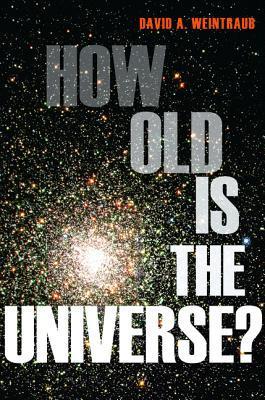
How Old Is the Universe?
Book Description
What if the answer to the cosmos’ most profound mystery lies in a single number? In "How Old Is the Universe?", David A. Weintraub unveils the thrilling journey of humanity’s quest to pinpoint the age of existence itself. From ancient stargazers to cutting-edge astrophysics, this captivating exploration reveals the monumental discoveries that have reshaped our understanding of time and space. As evidence collides with theories, each breakthrough unveils new questions that challenge everything we thought we knew. Can we truly grasp the vastness of the universe's timeline, or are we forever lost in its depths?
Quick Book Summary
"How Old Is the Universe?" by David A. Weintraub invites readers on an illuminating journey through humanity’s evolving attempts to answer a profound cosmological question: Exactly how old is our universe? Tracing efforts from ancient philosophical musings to cutting-edge modern science, Weintraub breaks down complex astronomical techniques and pivotal discoveries that gradually honed our understanding of cosmic time. The narrative weaves together the stories of influential scientists, critical observations, and revolutionary technologies, from early telescopic surveys to the precision of modern cosmology. Ultimately, Weintraub leads us to the current best estimate—around 13.7 billion years—while emphasizing the importance of scientific skepticism, ongoing inquiry, and the growing humility science inspires about our place in the cosmos.


![The Whole Shebang: A State-of-the-Universe[s] Report cover](https://images-na.ssl-images-amazon.com/images/S/compressed.photo.goodreads.com/books/1347278841i/310330.jpg)

Summary of Key Ideas
Table of Contents
Ancient and Cultural Notions of Time
Humanity’s desire to know the age of the universe dates back thousands of years. Ancient civilizations developed cosmologies and calendars rooted in myth, religion, and rudimentary observations, each arriving at vastly different answers. These early attempts, while unscientific by modern standards, laid important groundwork for viewing the universe as an entity with a beginning and, possibly, an end. As human understanding matured, astronomical records and cultural myths intertwined, establishing the age of the cosmos as one of philosophy and faith, rather than empirical measurement.
Astronomical Observation and Technological Advances
Progress accelerated with the advent of telescopes and advances in observational astronomy. Pioneers like Galileo and Hubble fundamentally changed our view of the cosmos, revealing the vastness of space and the existence of countless galaxies beyond the Milky Way. Critical milestones included the recognition of stellar evolution, advances in spectroscopy, and the ability to measure the number and distance of celestial objects. These developments enabled scientists to gather data that would eventually allow them to pursue more quantitative answers about the universe’s origin and age.
Measuring Cosmic Distances and Ages
Accurate measurement became essential, leading astronomers to develop ingenious methods such as using Cepheid variable stars as standard candles, supernovae brightness, and the study of globular clusters. Radioactive decay dating and the discovery of cosmic background radiation provided additional, crucial pieces to the puzzle. By triangulating results from multiple sources—stellar evolution, radioactive dating, and cosmic expansion rates—scientists could estimate the universe’s age with increasing confidence.
The Theoretical Framework: Big Bang and Expansion
Theoretical progress ran alongside observational breakthroughs. The Big Bang theory, inflationary cosmology, and the study of universal expansion provided the essential framework for interpreting measurements. With refined observations of cosmic microwave background fluctuations and careful mapping of the Hubble constant, cosmologists honed in on the number: roughly 13.7 billion years. Computer modeling, large-scale sky surveys, and improved instrumentation continuously sharpened this estimate, showcasing the power (and limitations) of science.
Living With Uncertainty and the Ongoing Search
Despite remarkable progress, Weintraub emphasizes that scientific inquiry is inherently provisional. Interpretations evolve, measurements improve, and uncertainties persist—whether due to unknown sources of error or the emergence of new data. The search for the universe’s age is a testament not only to human curiosity but also to the necessity of humility and adaptability in science. Ultimately, the quest to determine how old the universe is reveals as much about our methods and mindsets as it does about the cosmos itself, inviting us to embrace wonder in the face of the incomprehensible.
Download This Summary
Get a free PDF of this summary instantly — no email required.