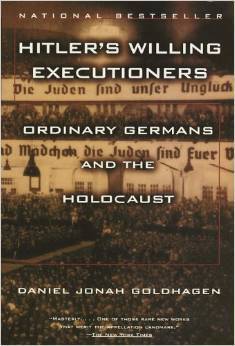
Hitler's Willing Executioners: Ordinary Germans and the Holocaust
Book Description
What if the darkest chapters of history were penned not by tyrants, but by ordinary people? "Hitler's Willing Executioners" digs deep into the chilling reality of how everyday Germans became complicit in the Holocaust. Through meticulous research, Daniel Jonah Goldhagen reveals the shocking truth about the motivations and beliefs that fueled an entire society’s participation in genocide. This gripping exploration confronts uncomfortable truths about human nature and society's capacity for evil. As the layers of denial are peeled back, one question lingers: How far will a society go when hatred is normalized?
Quick Book Summary
"Hitler’s Willing Executioners" by Daniel Jonah Goldhagen challenges the conventional view that the Holocaust was orchestrated solely by Nazi leadership and a handful of fanatics. Instead, the book argues that ordinary Germans were active, willing participants in the genocide, driven by deeply ingrained "eliminationist antisemitism." Drawing on extensive archival research, Goldhagen documents widespread brutality by members of the German police, army, and civilian administrators, contending that longstanding cultural beliefs made the mass murder of Jews not just possible, but broadly supported. The work confronts myths of ignorance and coercion, suggesting that many Germans committed atrocities with zeal. Through this controversial and provocative thesis, Goldhagen forces a critical reevaluation of collective responsibility and challenges societies to reckon with their darkest capacities.




Summary of Key Ideas
Table of Contents
Eliminationist Antisemitism as a Cultural Force
Goldhagen’s core argument is that antisemitism in Germany prior to and during the Nazi era was not merely a prejudice held by a fringe or stoked only by Nazi propaganda. Instead, it was a pervasive, deeply rooted cultural phenomenon that he terms "eliminationist antisemitism," which conditioned ordinary Germans to view Jews as a fundamental threat. This worldview called not just for separation or discrimination, but for the outright elimination of Jews. Over decades, societal, religious, and political currents fused to imbue the German population with these extreme beliefs, laying fertile ground for genocide the moment the state sanctioned it.
Ordinary Germans’ Willingness to Participate
To support his claim, Goldhagen meticulously examines the actions of ordinary Germans—policemen, soldiers, civilian officials—who directly committed or facilitated acts of violence. Using case studies such as the Reserve Police Battalion 101, he documents not just participation but the often zealous, voluntary involvement in atrocities. These men, mostly middle-aged and not indoctrinated Nazis, were seldom forced to kill, and many did so willingly, sometimes even brutally exceeding orders. This evidence challenges postwar portrayals of Germans as passive bystanders or reluctant participants.
Challenging the Myths of Coercion and Ignorance
Goldhagen actively confronts common arguments that downplay German culpability, such as the belief that most were either ignorant of the Holocaust or acted only out of fear for themselves and their families. He finds little support for these views in the historical record, noting that many perpetrators experienced little coercion or threat of punishment for non-participation. Opportunities to abstain or request transfer were available, yet only a minority took them. The book shows that awareness of, and participation in, the genocide was far wider than previously acknowledged.
Structures of Genocidal Bureaucracy
Examining the bureaucratic machinery, Goldhagen details how the Holocaust was not the result of orders from above alone but relied on the initiative and creativity of countless individuals at every level of government and society. Administrators, logisticians, and local authorities devised methods, tracked deportees, and innovated new ways to degrade and murder Jews. This decentralized enthusiasm exposes the banality of evil: monstrous acts perpetrated by ordinary people carrying out routine duties, rooted in deep-seated societal beliefs rather than solely ideological directives from Nazi leaders.
Implications for Understanding Human Nature and Responsibility
Finally, Goldhagen’s analysis has profound implications for how societies understand mass violence and their own moral vulnerabilities. The book warns that when cultural prejudices are normalized over generations, vast atrocities become possible, even likely, when enabled by state power. This insight challenges readers to reflect on collective responsibility, the dangers of prejudice and groupthink, and the urgent need for vigilance against ideological hatred in all societies. Through its unsettling findings, "Hitler’s Willing Executioners" compels ongoing debate about history, morality, and human nature.
Download This Summary
Get a free PDF of this summary instantly — no email required.