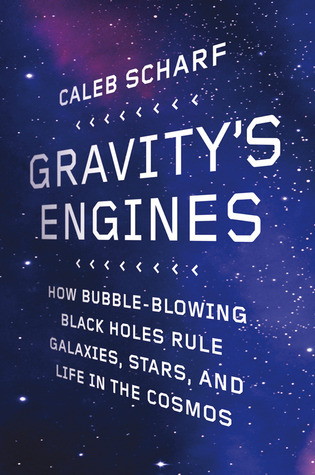
Gravity's Engines: How Bubble-Blowing Black Holes Rule Galaxies, Stars, and Life in the Cosmos
Book Description
Black holes are not just cosmic vacuum cleaners; they're the architects of the universe’s grand design. In “Gravity's Engines,” Caleb Scharf unveils the explosive secrets of these enigmatic giants, revealing how they shape galaxies, forge stars, and even influence the emergence of life itself. From the event horizon to the breathtaking dance of celestial bodies, this journey into the heart of darkness illuminates the profound connections that bind the cosmos. As black holes blow bubbles of energy and matter, they challenge everything we thought we knew about gravity and the universe. What if the key to understanding our existence lies in the throbbing embrace of these cosmic behemoths?
Quick Book Summary
In "Gravity's Engines," Caleb Scharf transforms our perception of black holes from mere cosmic destroyers to influential creators and regulators of the universe’s structure. He argues that black holes are critical architects, presiding over the birth and fate of galaxies, the formation of stars, and potentially the rise of life itself. Scharf deftly explains the complex science of accretion disks, energetic jets, and the bubble-blowing activity that black holes engage in, which, rather than just consuming matter, propel energy outwards and shape galactic environments. By weaving together astrophysics, observations, and the broader consequences of black hole dynamics, Scharf demonstrates how these enigmatic entities lie at the heart of cosmic evolution and connects their influence all the way down to the conditions necessary for life.




Summary of Key Ideas
Table of Contents
Black Holes as Galactic Architects
Caleb Scharf’s central argument in "Gravity’s Engines" is a paradigm shift: black holes are not just vacuum cleaners of the cosmos but are, in fact, pivotal in crafting the universe’s structure. Scharf explains how supermassive black holes reside at the centers of most galaxies and play a critical guiding role in their growth and evolution. Through observations of accretion disks and energy outflows, he demonstrates that black holes act as engines, regulating star formation and altering their galactic neighborhoods.
The Bubble-Blowing Phenomenon
A core theme of the book is the "bubble-blowing" behavior of black holes. Rather than simply swallowing matter, the process of accretion powers colossal jets and outflows, sending bubbles of high-energy particles into surrounding space. These actions are not destructive; they help redistribute matter and energy, preventing galaxies from collapsing under their own gravity and influencing the large-scale structure of the universe.
Feedback Loops and Cosmic Regulation
Scharf delves into feedback loops: when black holes create bubbles and jets, they heat the interstellar environment, limiting runaway star formation and stabilizing galaxies. This feedback mechanism is self-regulating, balancing the intake of matter with outflowing energy. The result is a dynamic system where black holes ensure that galaxies maintain conditions suitable for ongoing cosmic evolution.
Linking Black Holes to the Origins of Life
Crucially, Scharf connects these cosmic mechanics to the emergence of life. The regulation of galactic environments by black holes affects the chemical and energetic landscape in which solar systems like our own form. By moderating star formation and dispersing materials needed for planet-building, black holes may indirectly set the stage for habitable worlds and the rise of life, making their role profoundly consequential for our existence.
Throughout the book, Scharf combines cutting-edge research, analogies, and accessible explanations to reveal the scale and subtlety of black holes’ influence. He fosters both awe and understanding, challenging readers to rethink the forces that have governed the cosmos from the earliest epochs to the conditions that ultimately allow us to observe and contemplate our universe.
Download This Summary
Get a free PDF of this summary instantly — no email required.