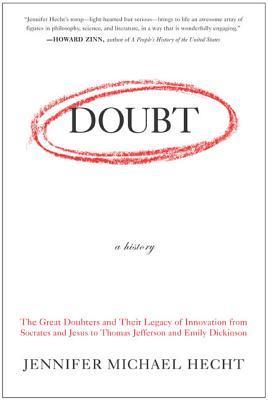
Doubt: A History
Book Description
Where does faith end and doubt begin? Jennifer Michael Hecht takes readers on an exhilarating journey through the ages, exploring the tumultuous relationship between belief and skepticism. From ancient philosophers challenging divine truths to modern thinkers grappling with uncertainty, this gripping narrative weaves together powerful stories of rebellion and revelation. Rich with historical insights and bold ideas, "Doubt: A History" reveals how doubt has shaped societies, inspired revolutions, and ignited the quest for knowledge. What if embracing uncertainty is the key to unlocking a deeper understanding of our world?
Quick Book Summary
"Doubt: A History" by Jennifer Michael Hecht explores the persistent and often overlooked tradition of skepticism and unbelief that has accompanied humanity’s search for meaning. Hecht traverses civilizations, examining how doubters—ancient Greeks, Indian atheists, Enlightenment thinkers, and modern scientists—challenged prevailing religious dogmas and inspired cultural progress. The book demonstrates that doubt is not merely a lack of faith, but a dynamic force driving inquiry, creativity, and even moral development throughout history. Hecht argues that doubters have shaped the intellectual fabric of societies, and suggests that embracing uncertainty can foster both personal and collective growth. By illuminating powerful stories of dissent and curiosity, she asserts that doubt is as essential as belief in understanding the human experience.


Summary of Key Ideas
Table of Contents
Doubt as a Creative and Moral Force
Hecht opens with the premise that our understanding of religious history often neglects the equally rich heritage of doubt. From the earliest times, societies have fostered individuals who questioned myths, rituals, and the authority of the divine. In ancient Greece, philosophers like Socrates and Epicurus posed tough questions about the gods and the origins of morality. Indian traditions, including some schools of Buddhism and materialist philosophies like Carvaka, also provided structured avenues for atheism and skepticism. These early doubters contributed not only to the rejection of blind faith but also to the emergence of rational debate and personal reflection.
Historical Roots of Skepticism
The narrative examines how, across history, expressions of doubt often ran parallel to or even intertwined with forms of belief. Medieval Jewish, Christian, and Islamic societies birthed their own skeptics, some of whom reconciled uncertainty with faith, while others faced persecution for their views. Doubt emerged as both a challenge and a complement to religious tradition, spurring theologians to refine doctrine and justify beliefs more rigorously. Sometimes, secular philosophies arose in reaction to social or political circumstances, illustrating the way that skepticism responds to wider cultural and historical currents.
Doubt versus Belief Across Cultures
In the Enlightenment, doubt shifted from being largely confined to intellectual elites to influencing broader social movements. Thinkers like Voltaire and David Hume critiqued religious institutions and championed scientific inquiry, laying the groundwork for a culture that valued evidence and reason over tradition. This expansion of skepticism inspired reforms in education, governance, and science, catalyzing the modern world’s approach to knowledge. Hecht stresses that questioning established truths was not just an end in itself but a means to foster progress and liberty.
The Modern Expansion of Rational Inquiry
The book explores how, in the 19th and 20th centuries, scientific advancements and secular philosophies further empowered doubt. Darwin’s theory of evolution, Freud’s analysis of religion, and existentialist reflections by thinkers like Nietzsche and Sartre intensified debates around faith and meaning. Hecht discusses how society oscillated between confidence in science and the temptation to return to comforting beliefs, demonstrating that doubt is a recurring, adaptive response to new uncertainties and discoveries.
The Ongoing Value of Uncertainty
Hecht concludes by emphasizing that doubt is not destructive but generative. Doubters—from ancient philosophers to contemporary scientists—have expanded humanity’s moral vision and knowledge base. Rather than dismiss doubt as negative or unfaithful, she argues we should embrace its capacity to inspire dialogue, humility, and innovation. The legacy of doubt, Hecht suggests, is a tradition as profound and influential as faith itself, reminding us that the quest for understanding thrives on questions as much as on answers.
Download This Summary
Get a free PDF of this summary instantly — no email required.