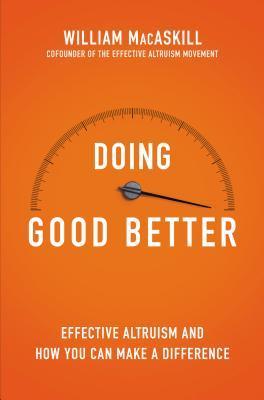
Doing Good Better: How Effective Altruism Can Help You Make a Difference
Book Description
Imagine the power to change lives with every decision you make. In "Doing Good Better," William MacAskill unlocks the secrets of effective altruism, revealing how careful choices can transform charitable efforts into monumental impacts. With compelling examples and thought-provoking insights, this groundbreaking guide challenges conventional giving and redefines success in the pursuit of doing good. As the world grapples with urgent social issues, MacAskill empowers you to think critically about where your efforts can create the most change. Are you ready to step into a more purposeful life and discover how your actions can ripple out to touch countless lives?
Quick Book Summary
“Doing Good Better” by William MacAskill introduces the philosophy of effective altruism, a movement that combines evidence and rational analysis to maximize positive impact in the world. Rather than advocating for charity based on emotion or tradition, MacAskill encourages readers to evaluate the true effectiveness of their actions and donations. Through compelling examples, he explains how some commonly accepted ways of helping can be surprisingly inefficient, while less obvious actions might save more lives or do more good. The book provides actionable tools and frameworks for individuals who want to make a tangible difference, guiding them in career choices, charitable giving, and long-term planning. MacAskill’s core message is that by thinking critically and using our resources wisely, anyone can dramatically increase the good they accomplish.



Summary of Key Ideas
Table of Contents
Maximizing Impact Through Evidence-Based Giving
William MacAskill’s approach in “Doing Good Better” begins by challenging the status quo of charitable giving and social action. He points out that traditional approaches often rely on intuition, emotional appeal, or proximity to a cause, which can lead to inefficient or even counterproductive use of resources. Instead, he suggests we use evidence-based reasoning and rigorous analysis, asking not simply “Is this a good thing to support?” but “Is this the best way I can use my resources to help others?” This shift lays the foundation for the philosophy of effective altruism, where doing good is both a moral and an intellectual pursuit.
Identifying the Most Pressing Global Problems
MacAskill delves into the importance of identifying the world’s most pressing problems. He provides a framework for ranking causes and charities based on scale (how large the problem is), neglectedness (how many resources are currently devoted to addressing it), and tractability (how solvable it is with additional effort). By reframing problems in these terms, readers are encouraged to focus on interventions that save the most lives, reduce the most suffering, or create the largest positive changes, rather than those that simply feel good or are familiar.
Rethinking Personal Career and Life Decisions
A significant portion of the book examines how individuals can make better choices—especially in careers and personal decisions—to maximize positive impact. MacAskill details the idea of “earning to give,” where one chooses a high-earning career to donate substantial portions to effective causes, as well as the value of direct work for high-impact organizations. He refutes the misconception that only traditional “helping” jobs, like working for charities, can be truly altruistic. Readers are encouraged to think broadly and strategically about where their skills and resources can do the most good.
Overcoming Common Intuitions and Biases
The book confronts common psychological barriers to effective altruism, such as the tendency to favor local causes over distant ones or to stick with familiar organizations. MacAskill highlights cognitive biases and emotional triggers that can lead to suboptimal choices. He advocates for developing habits of reflection, research, and critical inquiry, enabling individuals to bypass gut reactions in favor of actions with measurable, proven impact. Case studies illustrating both successes and failures of various humanitarian efforts reinforce the need for ongoing assessment and skepticism.
The Power of Collective Action and Advocacy
MacAskill concludes by exploring the collective power of movement-building and advocacy. He posits that while individual choices matter, systemic changes—such as influencing governments, institutions, or public opinion—can have orders of magnitude greater effect. By joining forces, sharing best practices, and spreading effective altruism principles, people can amplify their impact. The book thus ends on an empowering note, urging readers not only to act smarter as individuals but to help foster a culture where doing good better becomes the societal norm.
Download This Summary
Get a free PDF of this summary instantly — no email required.