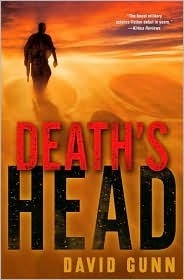
Death's Head
Book Description
In a galaxy ravaged by war, where death is as constant as the stars, a hardened soldier named Tathar wrestles with his own demons. Tasked with an impossible mission, he must navigate a world of betrayal, ruthless enemies, and his own haunted past. Allies are few, and trust is a luxury he can't afford. As the clock ticks down, the fate of countless lives teeters on the brink of chaos. With battles raging and darkness closing in, will Tathar defy fate, or will he become just another casualty of war? In a universe where survival is not guaranteed, who can really win?
Quick Book Summary
Death's Head by David Gunn plunges the reader into a relentless, war-ravaged galaxy where the line between survival and morality blurs. The story follows Tathar, a battle-hardened soldier under the banner of the elite but brutal Death's Head mercenary regiment. Haunted by a troubled past and distrustful of both allies and superiors, Tathar is thrust into an impossible mission with galactic stakes. As he maneuvers through shifting alliances, political intrigue, and brutal combat, Tathar grapples with personal demons and the ethical cost of his actions. The novel combines pulse-pounding battle scenes, nuanced world-building, and psychological tension to explore themes of loyalty, the cost of war, and what it means to live when death is always near. In the chaos of destruction, Tathar’s choices become the deciding factor between personal ruin and broader catastrophe.




Summary of Key Ideas
Table of Contents
The Brutality and Futility of War
Set in a galaxy torn apart by ceaseless warfare, Death's Head introduces readers to Tathar, a hardened soldier ensnared in a merciless universe. Serving the infamous Death's Head mercenary regiment, Tathar is shaped by the constant specter of death, having witnessed both allies and enemies fall with chilling regularity. Against this backdrop of unending conflict, the value of life is cheap, and the calculus of survival demands both physical and mental resilience.
Isolation and Trust in a Corrupt System
Trust emerges as a rare and precious commodity in Tathar’s world. Surrounded by political backstabbing and mercenary ambition, he operates within a system where betrayal is commonplace and loyalty is often a facade. Relationships are forged not through camaraderie, but by necessity and calculated risk. Every alliance is shadowed by suspicion, and Tathar is forced to rely on his instincts as much as his training to navigate the ever-shifting tides of loyalty.
The Psychological Toll of Violence
The novel delves deep into the psychological scars left by sustained violence. Tathar’s internal struggles — his recurring memories, guilt, and capacity for empathy — are contrasted with his ruthless efficiency in combat. The actions he is forced to undertake challenge his sense of self and morality. Through vivid internal dialogues and tense interactions, the novel explores how trauma shapes identity, pushing Tathar to the brink of emotional collapse even as he outwardly projects indomitable strength.
Survival Versus Morality
At its core, Death's Head is a study in the conflict between survival and moral consequence. Tathar is repeatedly placed in situations where he must choose between personal ethics and the brutal demands of the mission. The book does not shy away from the cost of these choices, highlighting the gradual erosion of ideals in the face of relentless adversity. Tathar’s struggle to maintain a sense of right and wrong underscores the broader question: In a universe defined by violence, can virtue survive, or is it merely another casualty?
Power, Betrayal, and Consequence
As the tension mounts, Tathar’s decisions ripple outward, affecting not only his own fate but the lives of countless others. Betrayals and unexpected twists escalate the stakes, culminating in a final confrontation that tests every lesson he has learned. The consequences of power, both wielded and suffered, form the backbone of the narrative. In the chaotic maelstrom of war, Tathar’s journey exemplifies the enduring human struggle to find meaning and agency, even when the odds are stacked against survival.
Download This Summary
Get a free PDF of this summary instantly — no email required.