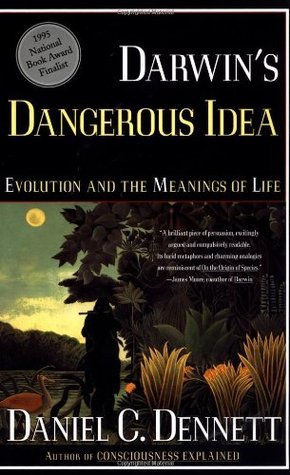
Darwin's Dangerous Idea: Evolution and the Meanings of Life
Book Description
What if the very essence of life itself held a dangerous secret? In "Darwin's Dangerous Idea," Daniel C. Dennett plunges into the revolutionary implications of evolution, unraveling the profound connections between life's complexity and our understanding of consciousness, morality, and existence. With sharp wit and compelling arguments, Dennett exposes the seismic shifts in thought prompted by Darwin's theory, challenging long-held beliefs and redefining the meaning of human life. As science collides with philosophy, what truths will emerge from the shadows of uncertainty? Are we merely the product of chance, or is there a deeper purpose waiting to be uncovered?
Quick Book Summary
"Darwin's Dangerous Idea" by Daniel C. Dennett explores how Charles Darwin's theory of evolution by natural selection fundamentally transforms our understanding of life, mind, and culture. Dennett argues that Darwin's idea is 'dangerous' because it undermines comforting views of humanity's special place in the universe, offering instead a vision of life as shaped by mindless, mechanical processes. With clarity and philosophical rigor, Dennett examines the implications of evolution for topics like consciousness, morality, and religion, challenging readers to reconsider entrenched beliefs. Through vivid metaphors and thorough analysis, Dennett reveals how Darwinian thinking is not only a scientific breakthrough, but also a philosophical revolution, reshaping the foundational concepts of existence, meaning, and human identity.


Summary of Key Ideas
Table of Contents
Evolution as an Algorithmic Process
Dennett positions evolution by natural selection as an algorithmic process: a simple but powerful mechanism without foresight or design. He emphasizes that evolution operates through cumulative selection, where small, random variations accumulate over time, leading to complex adaptations. This algorithmic nature challenges teleological explanations, replacing them with mechanistic accounts. Dennett uses analogies like “cranes” and “skyhooks” to illustrate how complexity can arise without invoking miraculous interventions, showing that mindless algorithms suffice to explain the development of life.
Universal Acid: Evolution’s Transformative Power
Central to the book is the idea that Darwin’s concept acts as a “universal acid,” dissolving traditional boundaries and assumptions across disciplines. By applying evolutionary thinking, long-standing distinctions between biology, mind, and society break down, revealing common patterns shaped by natural selection. This universal acid presents both exhilarating and unsettling implications. Dennett contends that evolution undercuts essentialist views of life, humanity, and purpose, compelling us to rethink where meaning originates in a seemingly indifferent universe.
Mind and Consciousness Explained by Natural Selection
Dennett extends evolutionary analysis to the human mind, exploring consciousness and cognition as products of gradual evolutionary pressures rather than unique, unexplained phenomena. He argues that natural selection can account for mental faculties once considered mysterious, such as language, intelligence, and moral reasoning. Rather than being irreducible, these capacities emerge from adaptive algorithms honed over millions of years, undermining dualistic or supernatural accounts of consciousness.
Challenging Religious and Philosophical Traditions
A significant portion of Dennett’s work engages with the challenges Darwinism poses to religion, spirituality, and traditional philosophy. He scrutinizes creationist critiques and philosophical resistance, highlighting how Darwin’s framework destabilizes notions of divine purpose or inherent teleology. Nevertheless, Dennett argues that embracing Darwin’s dangerous idea can ground a richer, more honest appreciation of life’s value, morality, and interconnectedness—even in the absence of traditional religious certainties.
The Evolution of Culture and Meaning
Finally, Dennett investigates the evolution of culture, language, and meaning through the concept of memes—units of cultural transmission and evolution. He shows how ideas, beliefs, and practices themselves evolve by mechanisms similar to natural selection. This perspective reveals culture as dynamic and adaptive, with its own evolutionary pressures and trajectories. Dennett concludes that Darwin’s idea is not just about biology but also about the deepest questions of human existence: how we think, feel, and create meaning in an ever-changing world.
Download This Summary
Get a free PDF of this summary instantly — no email required.