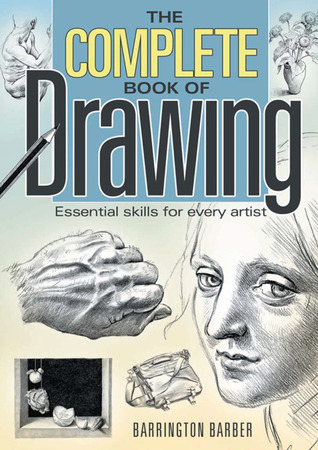
Complete Book of Drawing: Essential Skills for Every Artist
Book Description
Unlock the power of your creativity with 'Complete Book of Drawing: Essential Skills for Every Artist' by Barrington Barber. Immerse yourself in a dynamic journey through essential techniques that transform mere lines into breathtaking masterpieces. With step-by-step guidance and vivid illustrations, this book brings the art of drawing to life, igniting passion and honing skills that elevate any artistic endeavor. Conquer challenges from perspective to shading, and discover the secrets that will set your work apart. Are you ready to unleash your inner artist and redefine what’s possible on the blank page?
Quick Book Summary
Barrington Barber's "Complete Book of Drawing: Essential Skills for Every Artist" is a comprehensive guide tailored to artists of all levels who wish to refine their drawing abilities. The book covers fundamental techniques like line, tone, and shading, as well as more advanced concepts such as perspective and composition. Through clear explanations, step-by-step exercises, and illustrative examples, Barber demystifies the drawing process, making it accessible to beginners while enriching the skills of experienced artists. This resource not only strengthens technical proficiency but also nurtures creativity and confidence, enabling artists to depict subjects ranging from basic forms to complex scenes. By addressing common challenges and fostering critical observation, Barber equips readers with the essential tools to master the art of drawing and unlock their artistic potential.




Summary of Key Ideas
Table of Contents
Fundamental Drawing Techniques
The foundation of Barber’s method lies in mastering the core techniques of drawing—starting with simple lines and shapes, and gradually building up to more complex structures. He emphasizes the importance of understanding how to construct images step-by-step, beginning with the basics such as drawing straight lines, circles, and ellipses. These essentials are introduced with practical exercises designed to build muscle memory and confidence. As artists progress, they are guided through more challenging forms, learning how to recognize and replicate angles, contours, and overlapping shapes to create realistic representations.
Observational Skills and Visual Perception
A significant portion of the book focuses on the cultivation of observational skills. Barber encourages readers to train their eyes to see as an artist, breaking down visual information into understandable components. Through careful observation, artists learn to capture the essence and proportion of subjects, from still life to the human figure. Detailed demonstrations and practice sessions help develop the ability to analyze light, shadow, and form, teaching students to interpret what they see in order to improve accuracy and realism in their work.
Mastery of Perspective and Proportion
Understanding perspective and proportion is critical for constructing convincing three-dimensional images. The book covers single-point, two-point, and multi-point perspective systems, explaining how to represent depth and spatial relationships on a flat surface. Proportional guidelines and measuring techniques are introduced to ensure accuracy in subject placement and scale. Through clear diagrams and worked examples, Barber simplifies these sometimes daunting concepts, empowering artists to confidently draw anything from interiors and architecture to landscapes and complex arrangements.
Exploring Shading, Texture, and Tone
Shading, texture, and tone are essential for adding depth and vitality to drawings. Barber explores a variety of shading techniques—including hatching, crosshatching, and blending—to create volume and surface quality. He demonstrates how varying the pressure and direction of a pencil can evoke different textures and suggest light sources. Sample studies and exercises help artists experiment with gradients and contrast, enabling them to turn flat outline sketches into three-dimensional and emotionally engaging artwork.
Creative Expression and Developing a Personal Style
The final part of the book examines personal expression and artistic growth. Barber encourages experimentation, urging artists to move beyond replication to find their own voice and creative vision. He discusses developing a unique style by exploring different materials, approaches, and subject matter. The concluding chapters offer guidance on constructing compelling compositions and maintaining artistic motivation, concluding with a strong message about the importance of continuous practice, self-critique, and the joy of discovery on the artistic journey.
Download This Summary
Get a free PDF of this summary instantly — no email required.