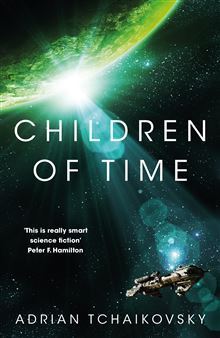
Children of Time
Book Description
On a world abandoned by humanity, evolution spins a new tale. A race of genetically enhanced spiders rises from the ashes of civilization, weaving intricate societies and complex hierarchies. As the remnants of humankind cling to survival aboard a dying ship, their destinies collide in a struggle for supremacy and understanding. Unraveling the threads of ambition and fear, both species must confront the questions of identity, morality, and what it truly means to be the master of one's fate. Who will inherit the stars when the legacy of humanity hangs in the balance?
Quick Book Summary
"Children of Time" by Adrian Tchaikovsky is an epic science fiction tale chronicling the parallel evolutions of two species: the remnants of humanity fleeing their ruined Earth, and a race of spiders uplifted by a failed terraforming experiment. As the human survivors aboard the starship Gilgamesh search desperately for a new home, the spiders on Kern's World build a flourishing civilization, advancing from the tribal era to a technological society. Over thousands of years, these two civilizations develop, adapt, and ultimately confront one another in a struggle that transcends species and time. The novel explores themes of evolution, intelligence, and empathy, challenging notions of superiority and prompting both races to question what it means to inherit the mantle of civilization.




Summary of Key Ideas
Table of Contents
Evolution and the Nature of Intelligence
The novel opens with Dr. Avrana Kern's ambitious experiment: to uplift monkeys on a terraformed planet using a nanovirus that accelerates intelligence and evolution. However, the experiment goes awry. Instead of monkeys, insects—spiders in particular—become the beneficiaries. Left behind by the collapse of human civilization, Kern's World evolves in isolation, while Kern herself persists as an AI echo, guiding and overseeing her inadvertent creations from orbit.
Civilization and Societal Development
Meanwhile, humanity itself is on the brink of extinction. The last survivors flee dying Earth aboard the Gilgamesh, a generation ship searching for a habitable planet. As they traverse the stars, they encounter the ruins of their own past, the challenges of leadership, and the psychological burdens of being the final bearers of humanity’s legacy. The crew's discovery of Kern’s World sparks hope and conflict—hope for a new beginning, and conflict with the unknown intelligence developing there.
Conflict and Empathy Between Species
On Kern’s World, the uplifted spiders, led initially by Portia and her descendants, develop into a thriving and complex civilization. They innovate unique solutions to technological and societal challenges, building communities structured by cooperation and communication. Their society evolves rapidly—from primitive tribalism to an advanced technological culture—driven by both necessity and the influence of the nanovirus. The spiders' trajectory provides a mirror to humanity’s own developmental path but diverges in unique and often surprising ways.
Legacy of Humanity and Inheritance
The encounters between humans and spiders are fraught with misunderstanding and fear. Humans, desperate to reclaim a world, view the spiders as adversaries, while the spiders perceive humans as destructive invaders. Their struggle embodies both the potential for violence and the capacity for empathy. Eventually, both sides face the realization that survival hinges not on domination but on understanding, acceptance, and the forging of a new coexistence. Key characters on both sides work to bridge the gulf, risking everything for the possibility of peace.
Morality and the Meaning of Progress
In its final reckoning, "Children of Time" upends traditional narratives of human superiority and inheritance. Both species are tested—morally, intellectually, and existentially. As the conflict reaches its climax, the survivors must choose between repeating the mistakes of the past or embracing a shared destiny. Tchaikovsky’s narrative ultimately suggests that true progress and survival require empathy, adaptability, and the willingness to redefine what it means to inherit the stars.
Download This Summary
Get a free PDF of this summary instantly — no email required.