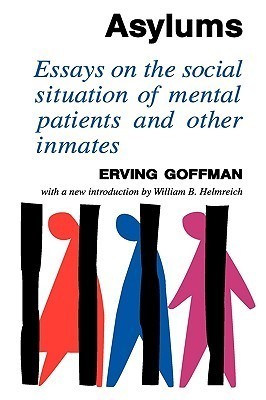
Asylums: Essays on the Social Situation of Mental Patients and Other Inmates
Book Description
What happens when society decides who is "normal" and who is not? In *Asylums*, Erving Goffman unravels the stark realities of mental institutions and the often grim social dynamics that entrap both patients and staff. Through compelling essays, he paints a vivid picture of life behind closed doors, exposing the dehumanization and stigma faced by those labeled as outcasts. Goffman's incisive observations challenge our understanding of identity, power, and humanity. As he navigates the shadowy corridors of confinement, what does it truly mean to be free in a world that relentlessly categorizes us?
Quick Book Summary
In "Asylums: Essays on the Social Situation of Mental Patients and Other Inmates," Erving Goffman provides a pioneering sociological analysis of mental hospitals and similar institutions. Drawing from his research at a mental hospital, Goffman explores how these 'total institutions' fundamentally reshape the lives, identities, and experiences of both inmates and staff. He details the process through which patients are stripped of their former identities, subjected to strict regimens, and forced to adopt roles dictated by the institution. Goffman highlights the dehumanizing aspects of such environments, emphasizing the loss of autonomy and the stigmatization that persists inside and outside these walls. Through vivid case studies and incisive theorizing, Goffman challenges conventional perceptions of mental illness and institutional care, questioning the broader social mechanisms that define normalcy and deviance.





Summary of Key Ideas
Table of Contents
The Concept of Total Institutions
Erving Goffman's groundbreaking work investigates the operations and effects of 'total institutions,' places where individuals are isolated from society and subject to strict regulations by authorities. Using mental hospitals as his primary example, Goffman extends his observations to other institutions like prisons, convents, and military barracks, where the boundaries between personal autonomy and institutional control are sharply drawn. He describes how such settings create environments that profoundly transform their inhabitants, reshaping identities and affecting the interactions between inmates and staff.
Mortification of the Self and Identity Transformation
A central theme of "Asylums" is the mortification of the self, a process where patients lose their previous identities through institutional practices. Upon entering the institution, individuals undergo rituals stripping away their autonomy, privacy, and distinctive personal features. Uniforms, restricted routines, and constant surveillance erode their sense of individuality. Goffman explains that these practices, intended to maintain order, often result in the dehumanization and psychological distress of patients, forcing a reconstitution of the self according to the institution’s demands.
Institutional Roles, Staff, and Power Dynamics
The relationship between staff and inmates is marked by stark power imbalances. Staff wield considerable authority, controlling every aspect of daily life and often justifying intrusive measures for the ‘good’ of the patient. The division creates an "us versus them" mentality, with staff reinforcing institutional norms and inmates developing coping strategies. Goffman reveals how this dynamic leads to alienation and resistance, with inmates developing subtle ways to reclaim power and agency, such as through rule-bending, secret exchanges, or forming supportive alliances.
Adaptation, Resistance, and Secondary Adjustments
Inmates adapt to institutional life through what Goffman calls "secondary adjustments." These are creative strategies used to carve out personal space and privacy within a restrictive environment. While some patients accept institutional expectations, others covertly resist or bend rules to assert their humanity. These small acts of defiance serve not only as coping mechanisms but also as means of maintaining dignity. Goffman emphasizes that these adaptations highlight both the resilience and the vulnerability of those institutionalized.
Stigma and Society’s Definition of Normalcy
The broader implications of Goffman’s analysis concern the concept of stigma. Patients, once labeled mentally ill and institutionalized, often carry a mark of shame that persists even after discharge. Society’s tendency to categorize individuals as normal or deviant perpetuates misunderstanding and prejudice. Goffman challenges prevailing notions about mental illness, urging readers to consider how societal processes, rather than inherent traits, produce and reinforce stigma and marginalization. "Asylums" thus stands as a landmark critique of institutionalization and its impact on identity, dignity, and social status.
Download This Summary
Get a free PDF of this summary instantly — no email required.