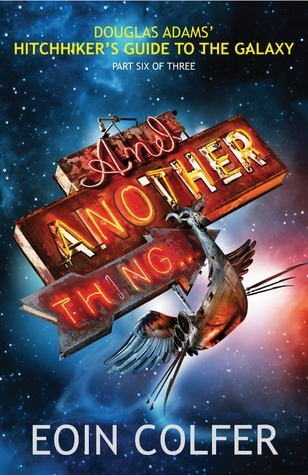
And Another Thing...
Book Description
The universe teeters on the brink of chaos as Arthur Dent finds himself hurled back into intergalactic mayhem, navigating a cosmic mishmash of absurdity and intrigue. With the very fabric of existence at stake, familiar faces reappear, alliances shift, and secrets unravel, leading Arthur on a wild ride through space and time. Every twist unveils deeper emotional stakes and fraught relationships, leaving him to confront his destiny. Can Arthur reclaim his life and align the stars before it’s too late, or will he be lost to the vast unknown? What happens when the fate of everything hangs by a thread?
Quick Book Summary
In "And Another Thing...," Eoin Colfer continues Douglas Adams' beloved Hitchhiker’s series, following Arthur Dent as he is once again swept into the chaos of outer space. The Vogons are bent on obliterating Earth (again), leading Arthur and his companions—including Ford Prefect, Zaphod Beeblebrox, and Trillian—on a race against cosmic destruction. Juggling new antagonists, improbable scenarios, and existential quandaries, Arthur must navigate not only external threats but also the complexities of his own relationships and sense of purpose. Old secrets and alliances surface as the crew journeys to the planet Nano, encountering Norse gods and bureaucratic nightmares. Humor, absurdity, and poignant reflection intertwine as Arthur faces his fate in a universe where nothing makes sense, yet everything matters.


Summary of Key Ideas
Table of Contents
Absurdity and Improbability in the Universe
Arthur Dent’s journey resumes in a universe once again on the brink of catastrophe. The story opens with Earth facing a renewed threat of annihilation, courtesy of the relentless Vogons and their bureaucratic devotion to destruction. Arthur, grappling with the endless unpredictability of the cosmos, is rejoined by familiar faces: Ford Prefect, the ever-resourceful hitchhiker; Zaphod Beeblebrox, the egotistical former president of the galaxy; and Trillian, who’s navigating motherhood and existential angst. Against the backdrop of this motley crew, Arthur’s struggles center as much on his search for normalcy and belonging as on surviving galactic mayhem.
The Persistence of Bureaucracy and Authority
The absurdity of cosmic life pervades every event. Improbable coincidences dictate the heroes’ fortunes, highlighting the universe’s refusal to offer clear logic or predictability. This unpredictability is personified by Zaphod’s harebrained schemes and the group’s encounters with Norse gods—including the puzzling deity Wowbagger the Infinitely Prolonged—whose personal vendettas further entangle the narrative. These events playfully critique human attempts to find meaning, suggesting life’s randomness is both maddening and oddly liberating.
Redefining Identity and Relationships
Authority figures, especially the Vogons, embody the inescapable persistence of bureaucracy. Their mindless dedication to rules and red tape, even as they seek the universe’s end, lampoons the potential destructiveness of unquestioned authority. Meanwhile, new planets such as Nano, organized by zealous colonists, reflect the human urge to replicate hierarchy even in new beginnings. The characters confront not just intergalactic threats but also the petty tyranny of administrative systems, revealing both the absurdity and endurance of institutional power.
Gods, Destiny, and Existential Loops
Throughout the narrative, deeper emotional currents emerge as Arthur and his friends grapple with their evolving identities and relationships. Arthur’s yearning for a settled life clashes with his role as a universal wanderer. Trillian faces the responsibilities of parenthood, while Ford and Zaphod struggle with loyalty and leadership. These emotional threads lend gravity to the humor and ensure that, despite the fantastical plot, the stakes remain personal and relatable. Each character’s search for connection and purpose underscores the challenge of self-definition in a universe that is constantly shifting.
Ultimately, the novel grapples with questions of destiny, free will, and cyclical existence. Confrontations with gods, choices about the fate of humanity, and the repeated near-destruction of Earth underscore the existential loops trapping the characters. The resolution challenges Arthur and his companions to assert agency and meaning where none seems forthcoming. Colfer’s entry channels the wit and satire of Douglas Adams, blending cosmic comedy with thoughtful rumination about existence, identity, and the farcical nature of fate. "And Another Thing..." both honors and extends the original series’ legacy with an irreverent yet reflective finale.
Download This Summary
Get a free PDF of this summary instantly — no email required.