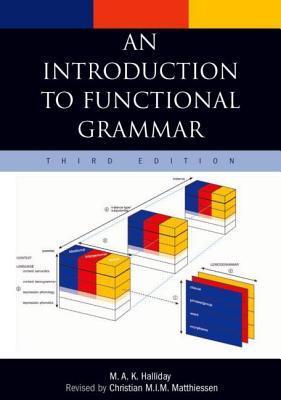
An Introduction to Functional Grammar
Book Description
Words can shape worlds, and in "An Introduction to Functional Grammar," M.A.K. Halliday unveils the powerful mechanics behind this transformative force. Dive into the intricate web of language that influences thought, behavior, and society. Discover how grammar is not just a set of rules but a tool for understanding human interaction and communication. Each chapter unfolds a new layer of meaning, revealing the profound connections between language and context. As you journey through this linguistic landscape, a question lingers: How will mastering the art of grammar change the way you perceive your everyday conversations?
Quick Book Summary
"An Introduction to Functional Grammar" by M.A.K. Halliday presents a groundbreaking perspective on the role of grammar in shaping language and meaning. Moving beyond traditional grammatical structures, Halliday’s approach investigates grammar as a dynamic system of choices that speakers use to make meaning in context. The book introduces foundational concepts such as metafunctions, which describe the multiple purposes grammar serves, including conveying ideas, enacting social relationships, and organizing discourse. With a focus on the interaction between language and context, Halliday demonstrates how grammatical structures reflect and shape our understanding of the world. This influential work empowers readers to view grammar not as a set of rules but as a tool for expressing thought, enacting social behavior, and navigating communication.





Summary of Key Ideas
Table of Contents
Grammar as a System of Choices
M.A.K. Halliday reconceptualizes grammar as a resource for making meaning, rather than a fixed set of prescriptive rules. Central to his functional model is the idea of grammar as a system of choices: speakers continually select among alternative grammatical structures to express particular meanings. This approach positions language as a flexible and adaptive tool shaped by the needs of its users, thus foregrounding the communicative functions of grammar over rigid correctness. Halliday’s perspective challenges traditional grammar pedagogy by emphasizing language’s role in constructing reality and fostering human interaction.
The Three Metafunctions of Language
A cornerstone of Halliday’s framework is the identification of three metafunctions that operate simultaneously in all utterances: the ideational (representing experiences and concepts), the interpersonal (enacting social relationships), and the textual (organizing linguistic elements into coherent discourse). Each metafunction reflects a fundamental purpose of language use, ensuring that grammar serves to construct knowledge, negotiate relationships, and structure communication. Halliday systematically illustrates how these metafunctions interplay to create meaning in any communicative act, shaping both individual utterances and broader discourses.
Context and Meaning-Making
Context plays an essential role in Halliday’s functional grammar. Language choices are understood in relation to the social and situational contexts in which communication occurs. Factors such as the field (what is happening), the tenor (who is involved), and the mode (how communication is carried out) all influence grammatical selections. Halliday’s methodology includes detailed analysis of authentic texts to show how context shapes language and vice versa. This sensitivity to context elevates functional grammar from mere description to a practical tool for discourse analysis and for understanding real-life communication.
The Role of Clause Structure in Communication
A crucial component of functional grammar is the focus on the clause, viewed as the central unit of meaning-making. The clause is analyzed for its contributions to all three metafunctions simultaneously, with special attention to processes (verbs), participants (nouns), and circumstances (adverbials). Halliday explores how elements such as transitivity, mood, and theme/rheme structures support varied communicative purposes. He demonstrates how the arrangement of clause elements enables speakers to highlight information, express attitudes or obligations, and construct logical relationships between ideas.
By uncovering the mechanics of how language works, Halliday’s functional grammar offers deep insights into communication, culture, and cognition. Through its systematic yet adaptable tools, the framework reveals the intertwined nature of language structure, meaning, and social interaction. It empowers readers to analyze texts of any genre, recognize the influence of context on language, and appreciate the creative and functional possibilities embedded in every act of communication. Ultimately, Halliday’s work transforms grammar from a mechanical exercise into a rich means of understanding the world.
Download This Summary
Get a free PDF of this summary instantly — no email required.