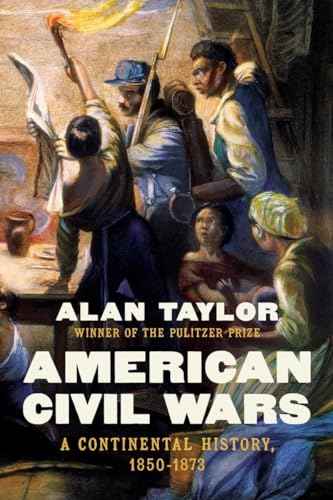
American Civil Wars: A Continental History, 1850-1873
Book Description
Rumble and chaos echo across the continent as the American Civil Wars ignite from the fringes of society, tearing apart families and communities in ways never imagined. Alan Taylor unveils a gripping narrative that dives deep into the fierce battles, shifting alliances, and heart-wrenching sacrifices from 1850 to 1873. Through the lens of struggle and resilience, the tumult shakes the very foundations of a nation, revealing the intricate web of politics and human emotion. What sacrifices will be made in the name of freedom, and who will emerge transformed in the aftermath of this relentless upheaval?
Quick Book Summary
"American Civil Wars: A Continental History, 1850-1873" by Alan Taylor expands the familiar narrative of the American Civil War, framing it within a broader continental crisis that swept across North America. Taylor examines not only the conflict between North and South, but situates the war’s origins and reverberations within the wider social, political, and racial upheavals from the U.S. to Mexico and Canada. By highlighting lesser-known borderland conflicts, ethnic violence, and shifting alliances, the book redefines the Civil War as part of a larger "civil wars" era. Taylor’s narrative interweaves the stories of universal struggle and resilience—families torn apart, reformers and radicals in motion, and political boundaries reshaped—showing how the era transformed nations and individuals on a continental scale.



Summary of Key Ideas
Table of Contents
Civil War as Continental Crisis
Alan Taylor reframes the American Civil War, challenging the common conception that it was a conflict isolated to the United States. He demonstrates how, beginning well before 1861 and lasting after 1865, cascading social, political, and racial conflicts swept across the entire continent. The turmoil affected not only the American South and North but also involved Mexico and Canada, as borderlands were sites of shifting alliances, migration, and ethnic conflict. Taylor demonstrates that the war’s influence was felt in the Mexican-American borderlands and within Canadian society, fundamentally destabilizing existing regional orders.
Impact on North American Borders and Societies
A central theme of Taylor’s analysis is that the war’s causes and repercussions were deeply tied to the question of race, freedom, and slavery. He details how the expansion of the United States westward fueled further tensions between states and peoples, especially as questions about slavery’s future in new territories provoked violence and sectional rivalry. Enslaved individuals and abolitionists played pivotal roles, transforming the war into a struggle over the very meaning of liberty and citizenship. The chaos led to widespread violence, including contested loyalties and guerrilla warfare in contested regions.
Role of Race, Freedom, and Slavery
Throughout the era, political and military alliances were dynamic and fluid. Native American tribes, immigrants, and political factions continuously shifted their allegiances to protect their interests or gain advantage. The period witnessed not just battles between armies, but a fractured society—land seizures, political coups, localized rebellions, and uprisings all contributed to a sense of relentless instability. Taylor illustrates how the involvement of foreign powers and the permeability of borders added another layer of complexity, making the era a true continental crisis.
Shifting Alliances and Political Upheaval
The book also explores the immense human cost of these overlapping civil wars. Taylor draws on personal accounts to show families and communities split by loyalties, conscription, and violence. The suffering endured by civilians—especially in border regions—was immense, with hundreds of thousands of lives upended. The era’s devastation was physical, social, and psychological, leaving scars and animosities that outlasted the formal end of combat. Yet, out of the destruction, new identities and political arrangements began to emerge as people and regions adapted to new realities.
Human Costs and Long-Term Transformations
In the aftermath, Taylor argues that the so-called "American Civil War" left behind a transformed continent. The Reconstruction period and its echoes in Canada and Mexico saw new debates around citizenship, national boundaries, race, and federal power. Taylor’s continental lens demands that readers reimagine the scale and significance of these wars, seeing them as shaping not just America, but the wider world. Ultimately, the period of 1850-1873 emerges not just as a national saga, but as a chaotic birthing ground for the modern North America we know today.
Download This Summary
Get a free PDF of this summary instantly — no email required.