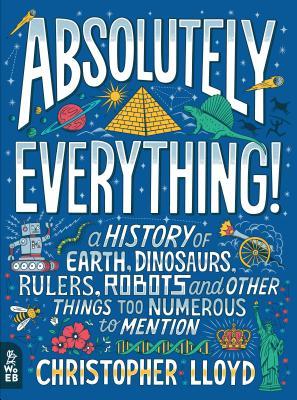
Absolutely Everything!: A History of Earth, Dinosaurs, Rulers, Robots and Other Things Too Numerous to Mention
Book Description
Step into a whirlwind journey through time that tears apart the fabric of history! From the reign of mighty dinosaurs to the rise and fall of rulers, and the dawn of robots, ‘Absolutely Everything!’ unveils the astonishing tapestry of our planet’s past. This vibrant exploration doesn’t shy away from the chaotic events that shaped civilizations, music, and ideas. With bold illustrations and riveting narratives, it brings the awe of existence to life. Every page teems with wonders waiting to be discovered. What surprising connections will you unearth in the saga of everything that ever was?
Quick Book Summary
"Absolutely Everything!" by Christopher Lloyd is a captivating journey through the entire history of our world, written for young readers but enjoyable for all ages. The book begins with the formation of the universe and guides the reader across epochs and continents, highlighting everything from the age of dinosaurs to the rise of humans, civilizations, and technological revolutions. Lloyd’s engaging narrative interweaves major scientific discoveries, the sweep of empires, and the mysterious connections between diverse historical events. The book makes vast, complex topics accessible, using vivid illustrations and dramatic storytelling to spark curiosity and awe about our planet. With a focus on both catastrophic events and amazing achievements, the book encourages readers to see the world as a dynamic and interconnected place, inspiring them to think about their role in its ongoing story.



Summary of Key Ideas
Table of Contents
Origins of the Universe and Life
The story begins with the birth of the universe, explaining the Big Bang, the formation of stars, and finally our own planet Earth. Lloyd artfully details the arrival and extinction of the dinosaurs, the emergence of mammals, and the evolution that led to humans. He reveals how simple beginnings, like single-celled organisms in an ancient ocean, paved the way for an astonishing diversity of life. The section sets the stage by emphasizing how every development in Earth’s history has laid the groundwork for the next.
Rise and Fall of Civilizations
As humanity emerges, the book traces the dawn of civilizations—from early hunter-gatherers to agricultural societies and the formation of cities. Lloyd explores pivotal societies such as Ancient Egypt, Greece, Rome, China, and the empires of the Americas. Through dramatic storytelling, he shows how empires rose and fell, often through war, innovation, or environmental change. This section highlights the patterns in history where the quest for knowledge and power push human societies forward, sometimes at great cost.
Discovery, Invention, and Scientific Progress
The reader is next invited to explore the rapid advancement of knowledge and technology throughout history. From the invention of writing and the wheel, to the marvels of navigation and great monuments, human curiosity is front and center. Lloyd celebrates scientific revolutions—like Galileo and Newton’s discoveries—and the Industrial Revolution’s massive changes. He also touches on more recent innovations such as computers and robotics, illustrating how invention continually transforms our way of life while also creating new challenges and opportunities.
Conflicts and Transformations
Conflict is a recurring theme, as the book delves into wars, revolutions, and social upheaval that have shaped civilizations. Lloyd explains how power struggles, the fight for freedom, and the collision of ideas have repeatedly altered the trajectory of history. From religious transformations to world wars, he breaks down both the destruction and the progress that arise from upheaval. The section paints a picture of how adversity can push societies to adapt and innovate, sometimes birthing new eras of prosperity or enlightenment.
Interconnectedness of History
Throughout, Lloyd weaves in the interconnectedness of all events in history. He shows readers how a volcanic eruption can spur migration, or how the Renaissance was influenced by ancient texts rediscovered after centuries. The book invites readers to draw connections between ancient events and modern life, inspiring awe at the relay of ideas and cultures over time. Ultimately, it challenges young readers to find their place in this ongoing epic, to learn from the past, and to imagine their role in shaping the future.
Download This Summary
Get a free PDF of this summary instantly — no email required.