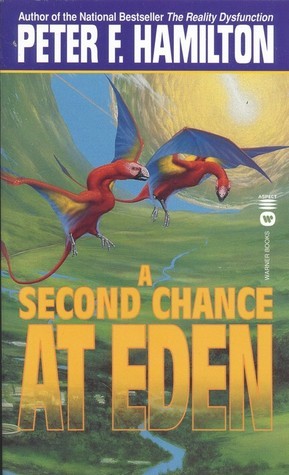
A Second Chance at Eden
Book Description
Amidst the ruins of a shattered universe, a battle brews over the fate of humanity’s last hope. A deadly virus threatens civilization while a covert faction harbors secrets that could reshape existence as they know it. As alliances fracture and loyalties are tested, a small group of unlikely heroes must confront their deepest fears and the ghosts of their pasts. With time running out and enemies closing in, they race to uncover the truth behind a mysterious Eden that could hold the key to salvation. Will redemption come in time to alter their destinies, or will darkness consume them all?
Quick Book Summary
"A Second Chance at Eden" is a gripping collection of interconnected stories set in Peter F. Hamilton’s far-future universe, exploring humanity’s struggle to survive and adapt against an ever-changing reality. Across these tales, a devastating virus sweeps through society, shattering the fragile peace and threatening to wipe out everything humanity has built. As society teeters on the edge of collapse, shadowy organizations and morally ambiguous individuals vie for dominance, each pursuing their own version of salvation. The enigmatic concept of 'Eden' — a utopian sanctuary — emerges as a symbol of hope, but also of manipulation and conflict. Amid technological wonders and existential threats, flawed heroes must grapple with the consequences of their choices, seeking redemption while confronting the very nature of existence.


Summary of Key Ideas
Table of Contents
Survival and Adaptation in a Shattered Future
Set within the same universe as Hamilton’s Night's Dawn Trilogy, "A Second Chance at Eden" weaves together a series of stories spanning three centuries of humanity’s expansion and turmoil. The backdrop is a future where humanity has mastered biotechnology, leading to the creation of affinity bonds, sentient habitats, and profound interstellar colonies. As progress accelerates, so too does the fragility of civilization, with catastrophic events—particularly a deadly virus—testing the limits of survival and forcing communities to adapt or perish in the aftermath of loss and upheaval.
The Dual-Edged Nature of Technology
Central to the collection is the tension between technological advancement and society’s ability to wield it responsibly. New technologies like the affinity link, originally intended to foster empathy and unity, become double-edged swords. They grant powerful advantages but also enable unprecedented manipulation, privacy invasions, and violence. Hamilton explores how these advances can both inspire hope—such as the promise of the enigmatic Eden habitat—and unleash chaos when harnessed by those with ruthless or misguided ambitions.
Moral Ambiguity and the Quest for Redemption
The stories highlight deep moral ambiguity, focusing on characters who navigate a web of personal trauma, difficult loyalties, and ethical dilemmas. Heroes are far from perfect; their paths are shaped by betrayal, loss, and the cost of their choices. Redemption is a recurring motif—some seek forgiveness for past actions, while others are consumed by revenge or a desire to control humanity’s fate. Through their struggles, Hamilton probes the human capacity for both evil and good, often blurring the distinction between the two.
The Power and Danger of Secrets
Secrets lie at the heart of much of the tension, as covert factions and hidden agendas drive the narrative forward. The clandestine knowledge of advanced biotechnology and the truth behind the virus and Eden habitat become battlegrounds. As revelations come to light, alliances shift, and characters must decide whom to trust, often with civilization itself in their hands. The consequences of secrecy reverberate, forcing all to confront what they truly believe in.
Hope, Despair, and the Search for Utopia
Throughout these interwoven tales, hope flickers against encroaching darkness. Eden—a technological and philosophical ideal—stands as a metaphor for humanity’s enduring quest for a better world. Yet, as the stories demonstrate, utopia remains elusive. Ultimately, "A Second Chance at Eden" challenges readers to ask whether salvation can be engineered, or if the journey toward redemption is as vital as its achievement. The collection offers a rich tapestry of intrigue, action, and reflection, examining humanity’s perpetual struggle to define itself in the face of transformation and existential threat.
Download This Summary
Get a free PDF of this summary instantly — no email required.