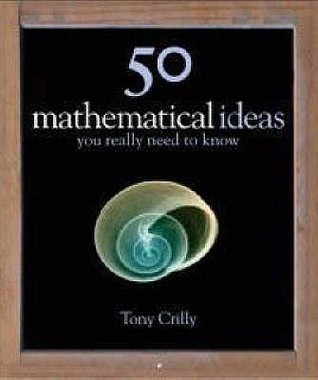
50 Mathematical Ideas You Really Need to Know
Book Description
Unlock the secrets that shape our world through the lens of mathematics. From the dizzying heights of infinity to the shadows of paradoxes, each chapter reveals a powerful idea that has transformed how we think, innovate, and understand the universe. Discover the magic behind prime numbers, explore the beauty of fractals, and unveil the mysteries of game theory. These concepts aren’t just numbers; they’re the building blocks of reality, influencing everything from technology to nature. As you journey through these 50 pivotal ideas, one question looms: how will your perspective shift when you see the world through the eyes of mathematics?
Quick Book Summary
“50 Mathematical Ideas You Really Need to Know” by Tony Crilly is an accessible and engaging exploration of the essential concepts at the heart of mathematics. Each of the 50 chapters distills a powerful idea, from the fundamental—like numbers, geometry, and algebra—to the more intriguing—such as chaos theory, game theory, and fractals. Crilly explains the history, application, and significance of each idea, demonstrating how mathematics shapes our understanding of the universe and influences fields as diverse as economics, technology, and nature. The book makes abstract concepts approachable, illustrating how mathematical thinking underpins the world we experience every day. Readers come away with a deeper appreciation for the elegance, creativity, and real-world impact of mathematics, regardless of their prior familiarity with the subject.
Summary of Key Ideas
Table of Contents
The Role of Patterns and Symmetry in Nature
Mathematics offers us a toolkit for deciphering and appreciating patterns in the natural and human-made world. Numbers, geometry, and algebra provide the foundation for recognizing structure and order in everything from flower petals to architecture. The concept of symmetry, for example, is not just an aesthetic principle but a mathematical rule manifest in crystals, snowflakes, and biological organisms. Mathematics allows us to formalize these repeating patterns, capturing the elegance and predictability that define so much of reality.
The Infinite and the Infinitesimal
Mathematical thinking often explores extremes—ideas of the infinite and the infinitesimal. Infinity captures the imagination: from never-ending numbers to endlessly dividing lines, it challenges our intuition about what is possible. Conversely, the study of limits, calculus, and infinitesimals enables us to model change and motion, thereby capturing phenomena from planetary orbits to the behavior of light. Such concepts have fueled philosophical debates and practical discoveries for centuries.
Chance, Probability, and Uncertainty
Uncertainty, chance, and probability are mathematical ideas that help us navigate a world filled with unpredictability. Probability theory allows us to quantify the likelihood of events, from rolling dice to predicting the weather. Concepts such as randomness, risk, and statistical patterns underpin fields such as insurance, economics, and even medicine, enabling decision-making in the face of incomplete information. Mathematics, therefore, brings structure to apparent chaos and lets us estimate, predict, and manage uncertainty in our lives.
Logic, Reasoning, and Paradoxes
Logic forms the backbone of mathematical proof and reasoning, ensuring that conclusions follow from premises in a reliable manner. Yet, mathematics is also home to paradoxes and surprising results, such as Gödel’s incompleteness theorem or the Monty Hall problem, which challenge our assumptions and highlight the limits of intuition. Grappling with paradoxes sharpens critical thinking, illuminating the boundaries of logic and often leading to deeper theories or new perspectives.
How Mathematics Drives Technology and Innovation
Many mathematical concepts underpin the technology and innovation that shape modern life. Cryptography secures our digital communications, algorithms power internet searches, and game theory informs business strategies and negotiations. Mathematics guides the simulation of weather, the modeling of the spread of diseases, and the design of efficient networks. Through abstraction and generalization, mathematics continually transforms our capabilities—driving progress and solving complex real-world problems.
Download This Summary
Get a free PDF of this summary instantly — no email required.