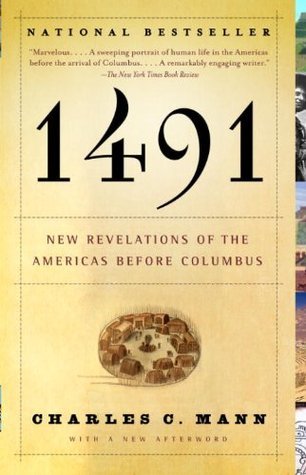
1491: New Revelations of the Americas Before Columbus
Book Description
What if everything you thought you knew about the Americas before Columbus was wrong? In '1491,' Charles C. Mann unveils a pre-colonial world teeming with sophisticated civilizations, vibrant cultures, and complex societies that defied the simplistic notions of savagery. History comes alive with tales of the Incas’ engineering marvels, the vast urban landscapes of the Aztecs, and the poignant connections between nature and humanity. This gripping journey shifts the narrative, revealing an era of ingenuity and resilience. What legacies of this rich tapestry have been lost to time, and how do they reshape our understanding of history today?
Quick Book Summary
"1491: New Revelations of the Americas Before Columbus" by Charles C. Mann challenges popular assumptions about pre-Columbian America, demonstrating that the continents were home to complex, populous, and technologically advanced civilizations long before European contact. Drawing on recent archaeological, anthropological, and ecological research, Mann illustrates that Indigenous peoples engineered their environments, maintained sophisticated societies with rich cultures, and profoundly influenced the landscape. Rather than untouched wilderness, the Americas were a tapestry of vibrant cities, engineered landscapes, and thriving trade routes. By exposing myths about the "pristine" New World, Mann redefines how we understand the history of the Western Hemisphere, underlining the legacy and contributions of its first peoples and highlighting how much has been lost or misunderstood through the lens of colonialism.


Summary of Key Ideas
Table of Contents
Debunking the Myth of the Pristine Wilderness
At the heart of "1491" lies the premise that the Americas before Columbus were far from a sparsely inhabited wilderness. Instead, they were home to millions of people who actively shaped their environments. Mann reveals that the popular image of untouched forests and vast empty plains is a myth, propagated by early European settlers who unknowingly witnessed landscapes already altered by disease and disruption. Recent research suggests that Indigenous peoples had transformed much of the land through techniques like controlled burns, agriculture, and settlement construction, leaving a lasting human imprint on the continents.
Sophistication of Indigenous Civilizations
Mann delves into the complexity and diversity of the civilizations that flourished across the Americas. From the Inca roads and terraces winding through the Andes, to the vast, intricate city of Tenochtitlán built by the Mexica (Aztecs), Indigenous societies orchestrated impressive feats of engineering, agriculture, and governance. These cultures developed writing systems, monumental architecture, sophisticated calendars, and far-reaching trade networks, indicating a level of advancement comparable to Europe or Asia. Such achievements defy the longstanding Eurocentric narrative of Indigenous peoples as isolated and technologically backward.
Ecological Engineering and Landscape Management
A key theme Mann explores is how Native Americans manipulated their environments to meet their needs, creating landscapes abundant with biodiversity and food resources. The Amazon rainforest, often portrayed as wild and untouched, was actually a managed ecosystem shaped by centuries of Indigenous agricultural practices, including the creation of fertile soils called terra preta. Techniques such as irrigation, terracing, and selective planting fundamentally altered ecosystems, demonstrating an acute understanding of ecological balance and sustainability—a legacy often underappreciated in Western scholarship.
Population Estimates and Societal Impact
Another groundbreaking aspect of "1491" is the reconsideration of the population numbers in the Americas on the eve of European contact. Mann presents evidence that populations were not only large, perhaps totaling 100 million or more, but also densely settled in many regions. Catastrophic waves of disease brought by Europeans decimated Indigenous communities, leading to societal collapse and massive depopulation. When later generations of Europeans arrived, they saw empty lands and misinterpreted them as evidence of perpetual wilderness rather than post-apocalyptic landscapes.
Enduring Legacies and Losses
In redefining the pre-Columbian Americas, Mann emphasizes the enduring legacies and tragic losses caused by conquest and colonization. He invites readers to reflect on how much knowledge, culture, and ecological wisdom vanished in the wake of European arrival. These revelations reshape current understanding of history and challenge us to reexamine longstanding prejudices. Far from being passive inhabitants, Native Americans were active agents who shaped their worlds and whose influence continues to be felt, albeit often unrecognized, today.
Download This Summary
Get a free PDF of this summary instantly — no email required.